
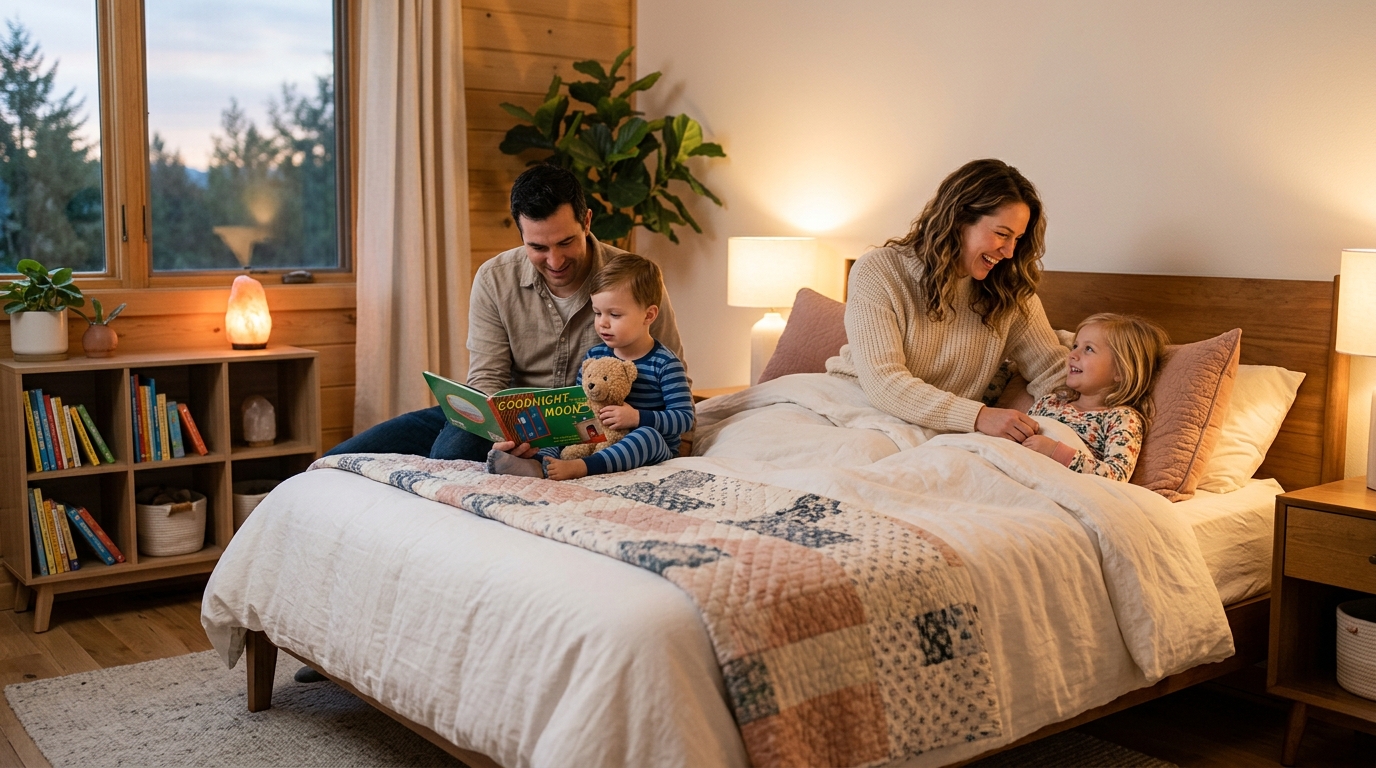
It was 9:47pm on a Wednesday, both kids were still awake, my four-year-old was crying because her pajamas felt “spiky,” my seven-year-old had just announced he needed a glass of water for the third time, and my partner and I were sitting on the floor of the hallway outside their bedrooms, quietly losing our minds. We had been doing bedtime for two hours. Two hours. For a routine that, by every parenting book I’d skimmed, was supposed to take thirty minutes.
That night was the rock-bottom moment. When the kids were finally asleep, my partner turned to me and said, “This cannot keep happening.” I agreed. We opened a bottle of wine and spent the next two hours talking — not about what the kids were doing wrong, but about what we were doing wrong. By midnight we had a rough plan. Over the next three weeks we rebuilt our bedtime routine from scratch.
I’m not going to tell you our kids now go to sleep angelically every night. They don’t. Most nights, though, the whole thing takes about 30-40 minutes, ends with everyone relaxed, and doesn’t involve either parent crying in the bathroom afterward. That’s the honest version of success. Here’s how we got there.
The Night We Cried More Than the Kids Did
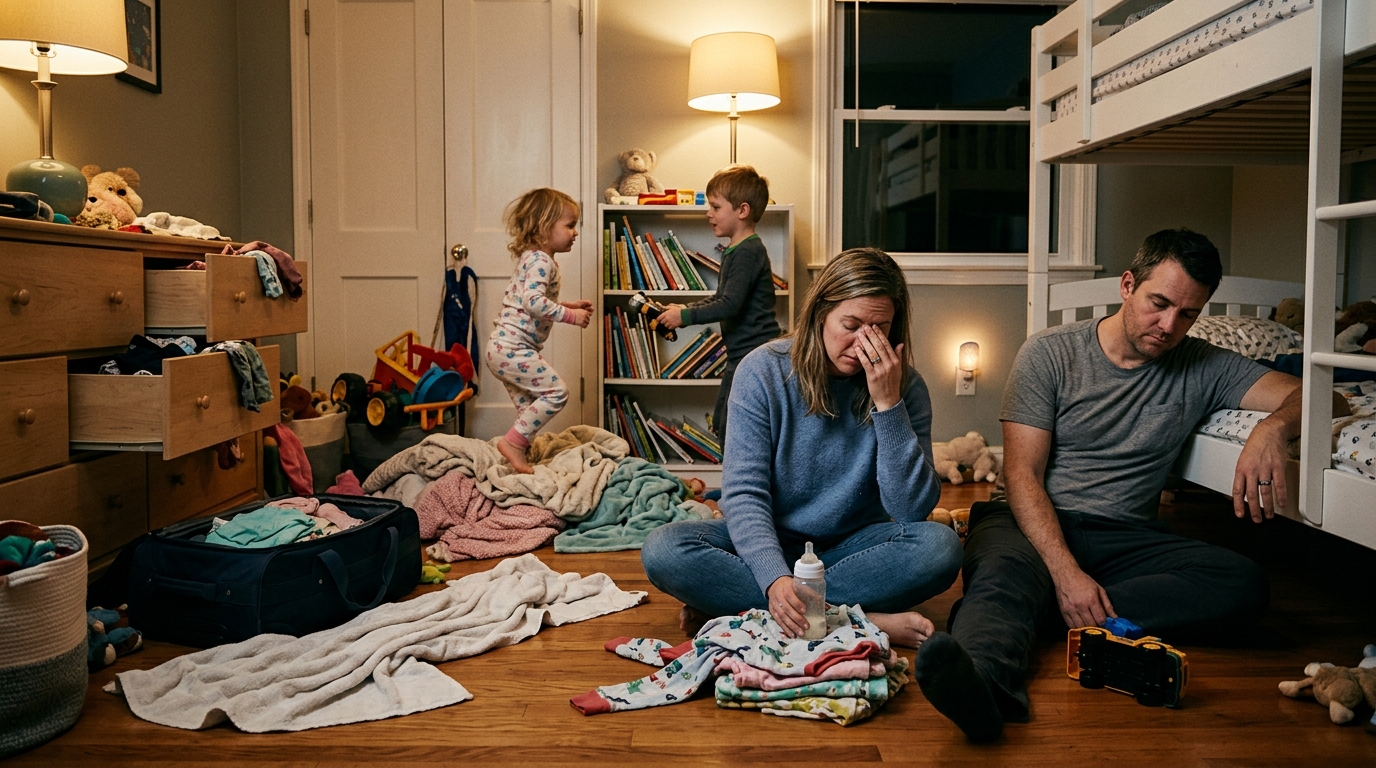
Before I get to the solution, I want to be honest about what bedtime looked like in the “before” era, because if you’re in it now, I want you to know you’re not failing — the system is.
Our old routine, if you can call it that, was basically a running improvisation. Dinner ended whenever it ended. Then there was some vague amount of play. Then, at some point, someone would say “okay, teeth,” and the rest of the evening was a cascade of negotiations: bath or shower? whose pajamas were clean? which book? why was the tooth-brushing taking eleven minutes? why was there screaming from the bedroom? why was anyone still in the bathroom?
The individual components of our bedtime weren’t the problem. Bath, teeth, pajamas, story, goodnight — standard stuff. The problem was that every single step required a decision, and every decision was an opportunity for the kids to litigate. “Can we read two books?” “Do I have to brush my teeth tonight?” “Can I have the blue cup?” Each question, innocent alone, joined together into a two-hour ordeal.
The breakthrough insight came from my partner, who was reading a parenting book about kids’ nervous systems, and pointed out that we were essentially trying to wind the kids down while also making them make dozens of small choices. Tired kids making choices is a recipe for meltdowns. We needed to remove the choices.
That framing changed everything for us. The goal of bedtime wasn’t to complete a list of tasks. The goal was to build a low-choice, predictable glide path that the kids’ bodies could follow without thinking. If the route was the same every night, their nervous systems could start the wind-down before their brains did.
The Three Shifts That Made the Biggest Difference
Once we understood that the problem was choice-load and unpredictability, the fixes got concrete fast. There were three shifts that did 80% of the work.
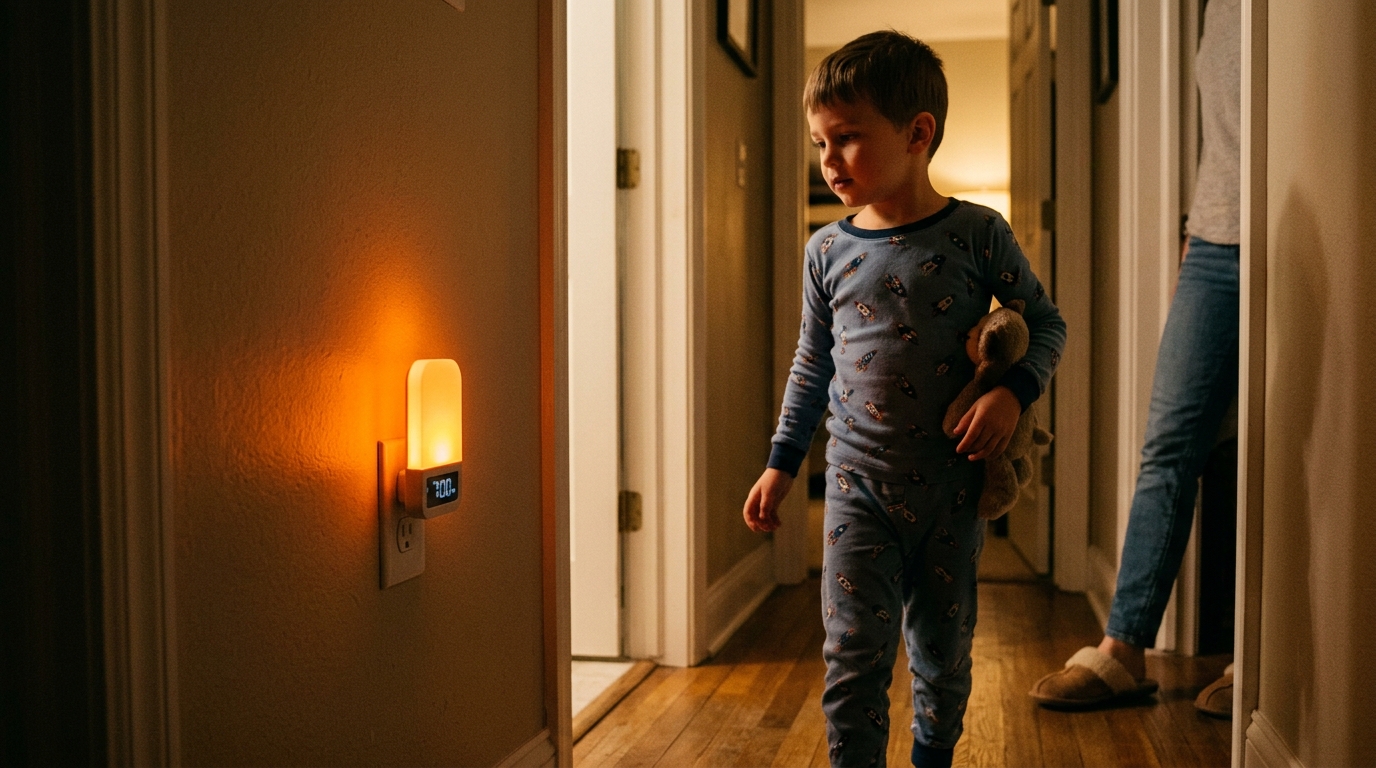
Shift one: a fixed start time, triggered by a signal, not a decision. We set 7:00pm as “bedtime starts.” Not “bedtime is at 7,” not “around 7,” but a specific, sacred moment. Our way of marking it: a color-changing night light in the hallway that shifts to orange at 7:00pm. When the light changes color, bedtime has started. It’s not a conversation. It’s not negotiable. It’s just what the light is doing.
That single change — outsourcing the announcement of bedtime to a device rather than making a parent say “okay, time for bed” — removed a stunning amount of resistance. You can’t argue with a light.
Shift two: a visual routine chart, for the younger kid especially. We bought a magnetic routine chart and hung it at kid-height in the hallway. Six steps, with little illustrations: bath, pajamas, teeth, story, snuggle, lights out. After each step she moves the magnet. The chart did two things simultaneously: it gave her a sense of control (she’s moving the magnets, she’s driving the process), and it took the what’s next decision out of our mouths.
Our seven-year-old doesn’t need the chart, but watching his little sister do it has weirdly become part of his routine — he now checks her progress and sometimes reminds her what’s next. The chart became a collaborative object, which I didn’t predict.
The third shift was the deepest and the slowest to land.
Our Exact 30-Minute Routine, Step by Step
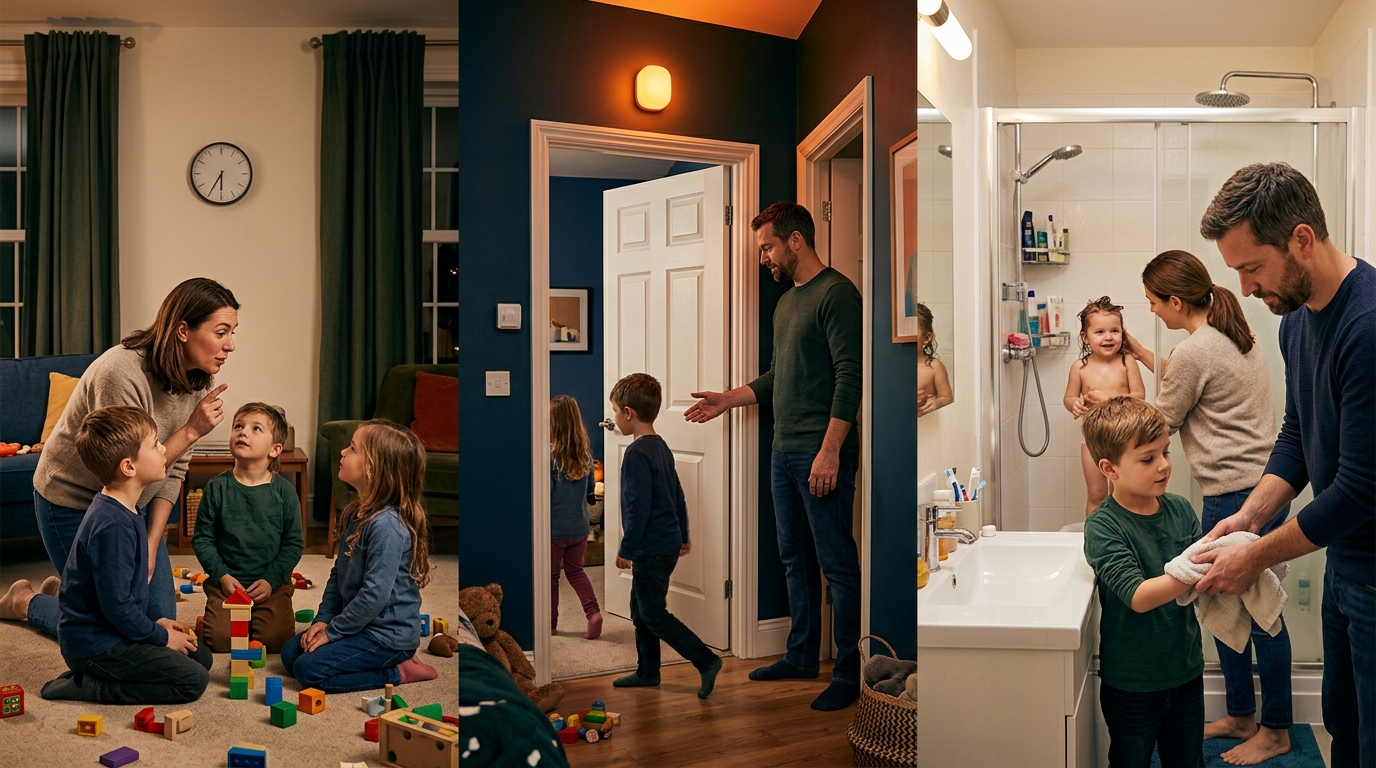
Here’s the current routine. I’m giving you the whole thing because I know that when I was in the thick of it, I wanted to read somebody else’s actual routine, not a generic framework.
- 6:55pm — Five-minute warning. One of us says, gently, “five minutes till the light turns orange.” Not a question, not a negotiation. Just information.
- 7:00pm — Light turns orange. Bedtime starts. Whatever play is happening stops within two minutes.
- 7:00-7:10pm — Bath or shower. Alternating nights: younger first, older first. Non-negotiable order to avoid jealousy.
- 7:10-7:15pm — Pajamas and teeth. They do this more or less on their own now. We’re present but not directing.
- 7:15-7:20pm — Water, bathroom one last time, snacks of the very small kind. The “I need a X” prevention window. All needs must be stated now.
- 7:20-7:35pm — Story time. Both kids, on the older one’s bed. One chapter of a shared book, then one picture book for the younger one. No negotiations about number of stories. One and one.
- 7:35-7:40pm — Snuggle in own beds. We sit briefly with each, in turn. A short exchange, a specific kind thing about their day, a kiss.
- 7:40pm — Light out. Sound machine on low, night light soft. Parents leave the room and close the door.
A calm, pre-warmed bed makes a remarkable difference for the four-year-old. We got her a small lightweight weighted blanket after she kept complaining about feeling “floaty” at bedtime, and it reduced her get-up-again requests significantly. Weighted blankets aren’t for every kid, but if yours is the type who’s always squirming for something to push against, it’s worth trying.
One detail that matters: both parents are present for the first year of running any new bedtime routine. This is the opposite of the old pattern where one parent does bedtime while the other cleans up dinner. We split duties during the day so that both of us could be in the kids’ hallway between 7-7:40. The kids couldn’t play us off each other, because we were both there. Now, a year in, we can take turns, but starting with both was what made the new routine stick.
What We Stopped Doing (And Why It Mattered)
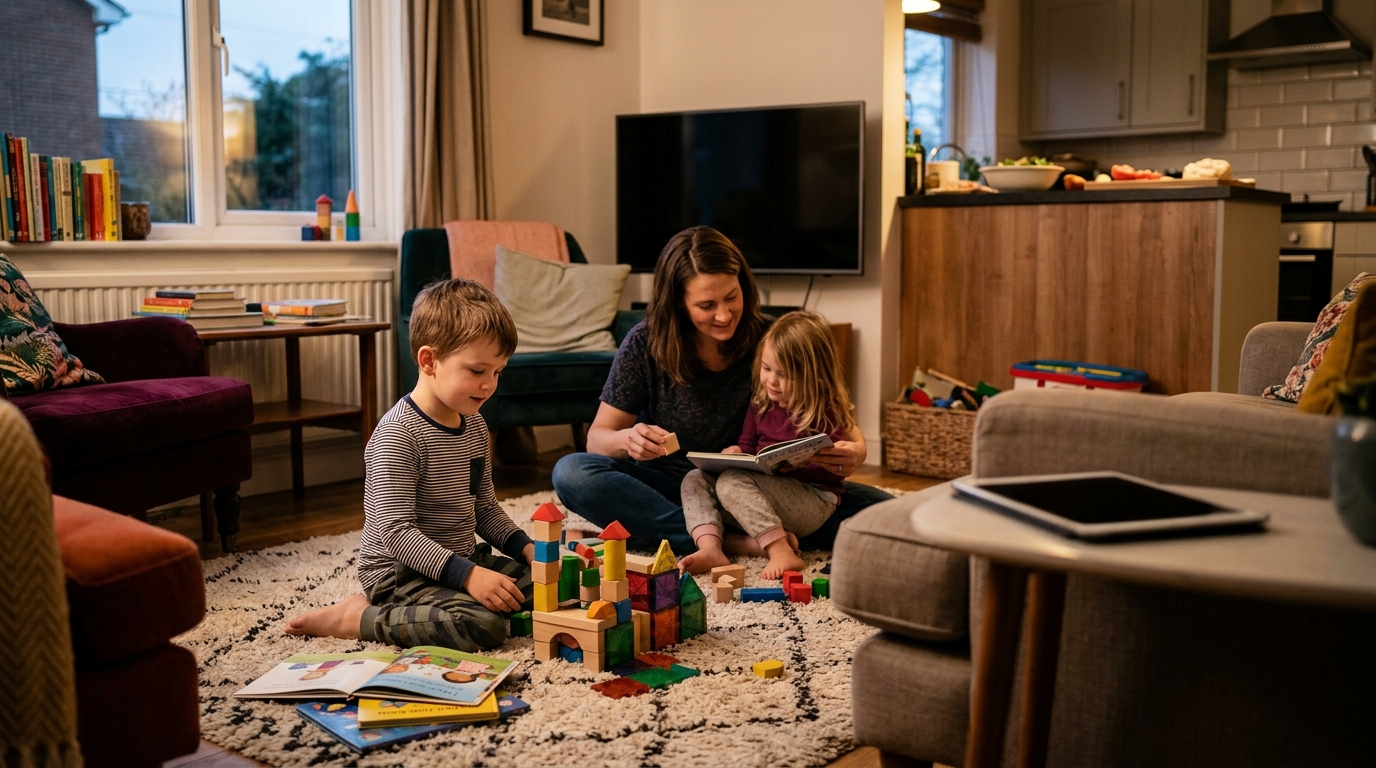
We also had to cut a few things, which was harder than adding things.
We stopped screens after 5:30pm. This was the single hardest change. Screens are parental oxygen in the dinner-and-cleanup window. We gave them up in the evenings because the research on screen-light-and-bedtime is overwhelming, and because we could directly feel that kids’ moods after screens were worse than their moods after unstructured play or books. Not easier for us. Much, much better for the kids.
We stopped bedtime snacks more than a nibble. They’d become a delay tactic. “Can I have a snack?” is unanswerable by a good parent in any direction — yes means a production, no means a meltdown. We pre-empted it: snack-sized snacks at 6:45pm, a small fruit or a few crackers, baked into the pre-routine. Once that became the pattern, the 7:30 “I’m hungry” dropped away entirely.
We stopped letting the older kid read alone in his room past bedtime. This was a habit we’d started as a treat, and it had quietly turned into an hour of him lying in bed with a light on. The new rule: reading is part of the shared story time. After lights out, lights stay out. He wasn’t happy about this for about a week. Then his sleep improved, his mornings improved, and the complaint dropped.
And — the one I’m not proud of — we stopped raising our voices at bedtime. Or rather, we stopped accepting it in ourselves. We’d both been yelling, a low-level kind of exasperated yelling, too often. It was a symptom of the two-hour ordeal, not a cause. But the yelling itself was training the kids to meet bedtime as a combat zone. When we cut it, the room’s whole energy changed.
An honest admission: I had one terrible night six weeks in where I yelled anyway, because the four-year-old threw a complete tantrum and I was exhausted, and all the new routine structure collapsed in that moment. I apologized to her the next morning and told her I’d been wrong to yell. That conversation, weirdly, was one of the most valuable moments of the whole project.
The Weeks It Still Falls Apart — and How We Recover

I don’t want to pretend this is solved. It isn’t. About once every two weeks, bedtime goes off the rails. Usually it’s because of a specific trigger: a big weekend, a late nap, a kid who’s getting sick, a disruption in the routine (a sleepover, a guest, travel). These are the nights that used to convince me the whole project was failing.
What I’ve learned is that a bad night is not a regression. It’s a data point about what the routine can and can’t absorb. Our recovery protocol, which we mostly follow:
- Don’t try to fix it in the moment. Finish the night with whatever compromises you have to make. Don’t try to reassert the routine against an already-dysregulated kid.
- The next morning, don’t litigate it. No “remember last night.” Just return to the routine calmly at 7pm.
- If it happens two nights in a row, go to the chart. Walk through what actually happened. Usually one trigger jumps out.
- Accept that one bad night in ten is probably the ceiling of what’s achievable with young kids.
The mental shift was accepting that the routine is a default, not a guarantee. On most nights, it works. On some nights, biology wins. You return to the default the next night.
Final Thoughts: The Unexpected Gift of a Boring Bedtime
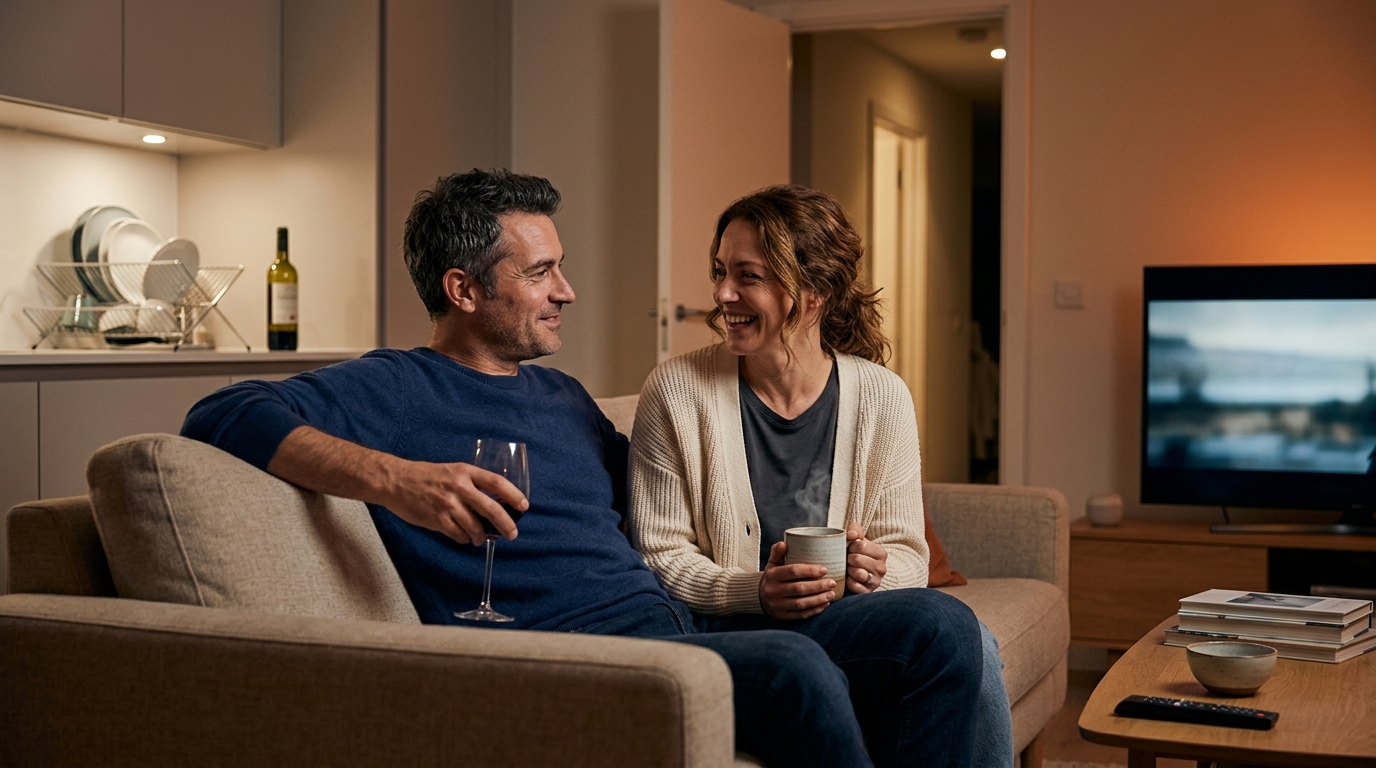
Here’s the thing I didn’t expect when we started this. The payoff wasn’t just earlier bedtimes. It was an evening back. My partner and I got an entire chunk of our marriage back — the 8pm-to-10pm window we hadn’t had in years. We cook slowly now. We talk. We watch something. We go to bed ourselves at a reasonable hour. I hadn’t realized how much the two-hour bedtime had been eating into everything else.
I also hadn’t realized how much my kids wanted the structure. They weren’t fighting bedtime because they loved chaos. They were fighting because an unpredictable bedtime asks kids to make too many decisions at the end of a long day. A predictable one gives them a glide path to sleep. They end up more rested. They wake up easier. They’re easier to be around the next morning. The whole system compounds.
Boring is the feature, not the bug. A boring bedtime routine is one the kids’ nervous systems can trust. Trust is what makes sleep possible.
If you’re in the rough version of this right now, I have three small pieces of advice. First, pick a hard start time and mark it with something non-parental — a light, a song, a timer. Second, remove as many decisions from the routine as you possibly can. Third, accept that you’ll need both parents present for the transition, for longer than you think.
A year in, my four-year-old now goes into the bathroom on her own when the light turns orange. My seven-year-old finishes his teeth before I ask. These are small gestures that, to anyone watching from the outside, would look unremarkable. To me, they look like everything we were missing on that 9:47pm hallway floor a year ago. Worth every awkward week of rebuilding.






Leave a Reply