

I keep a running tally on the back of a receipt stuck to my fridge. It’s labeled “Stuff I Didn’t Replace”, and last December, when I added up the numbers, I stared at it for a full minute before showing my partner. $2,037. That was the amount I’d saved over twelve months simply by fixing things instead of buying new ones.
It started as a stubborn reaction to a $340 appliance repair quote. The dishwasher had stopped draining, and the technician who stopped by took exactly four minutes to diagnose a clogged drain hose before quoting me the price of a small vacation. I paid him the service fee, walked him out, watched a fifteen-minute YouTube video, and had it working again by dinner. The part cost six dollars.
What changed that day wasn’t my wallet — it was my default. For most of my adult life, when something broke, my first instinct was replace. Not anymore. Let me walk you through what a year of repair-first living actually looks like, what tools earned their keep, and the handful of mistakes that taught me when to swallow my pride and call a pro.
The Shift That Started It All
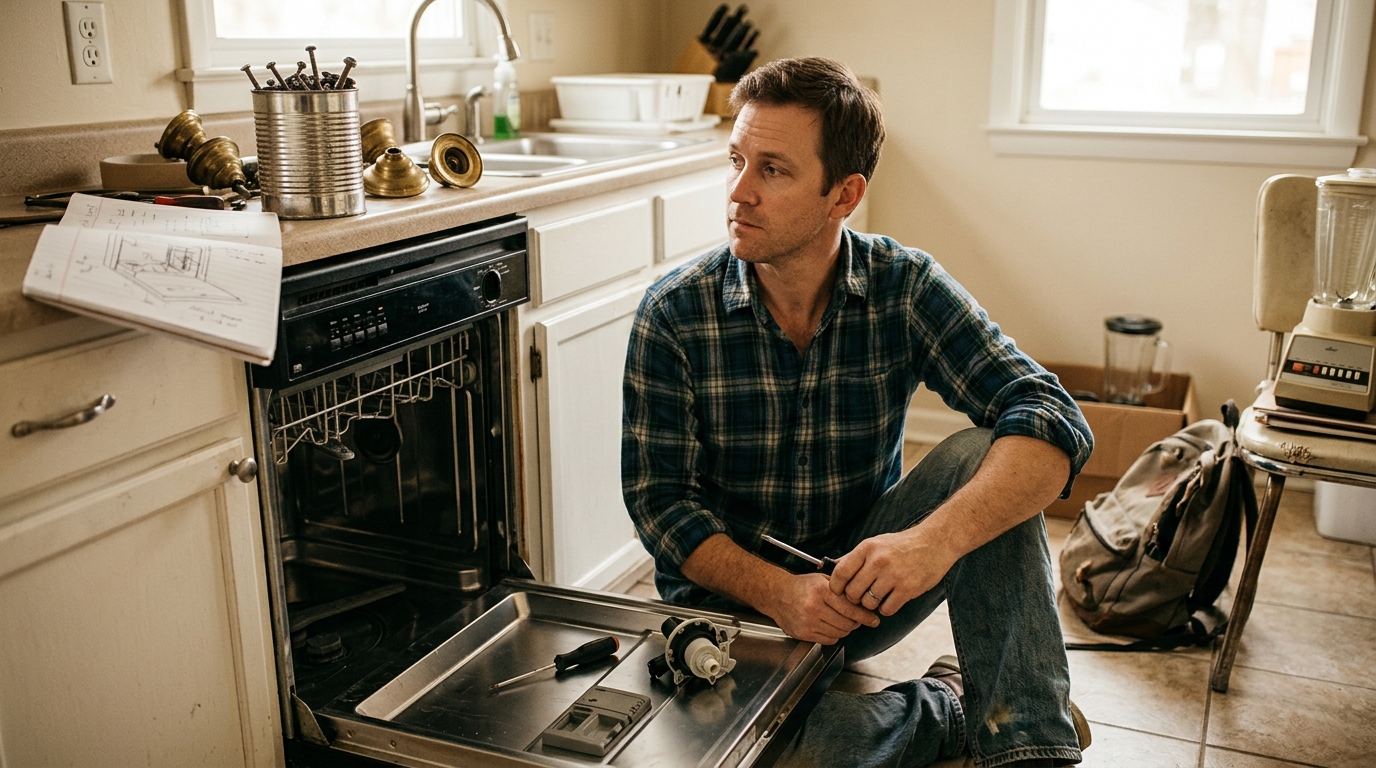

The dishwasher incident wasn’t the first thing I’d ever fixed, but it was the first time I truly noticed how much I’d been outsourcing my own competence. Growing up, my dad kept a coffee can of mismatched screws and a Sunday habit of fixing lamps. Somewhere between college and homeownership, I’d traded that entire mindset for convenience. A ripped backpack? Donate it. A wobbly chair? Curb it. A dead blender? Amazon two-day shipping.
The real cost of that mindset wasn’t just money — it was the quiet learned helplessness that comes with treating every object in your home as disposable. I started keeping that receipt tally partly to track savings, partly as a sort of proof to myself that I could still do things.
The rules I set were loose but honest. If something broke, I’d spend fifteen minutes researching whether it was fixable at home before deciding to replace. If the repair cost more than half the price of a new one, I’d consider replacing. If it involved gas lines, major plumbing, or anything electrical behind the wall, I’d call a professional. Everything else was fair game.
The surprising part was how quickly I stopped needing to consult the rules. After a few months, the default flipped. Broken thing? Fix it. The mental friction disappeared, and so did the reflexive Amazon cart-building that used to follow any household failure.
What I didn’t expect was how much this one habit rippled into other areas. I started buying higher-quality things up front because I knew I’d keep them longer. I donated fewer items because I wasn’t cycling through them as fast. And I stopped feeling quite so helpless in my own house.
The Repairs I Tackle Myself (and How)
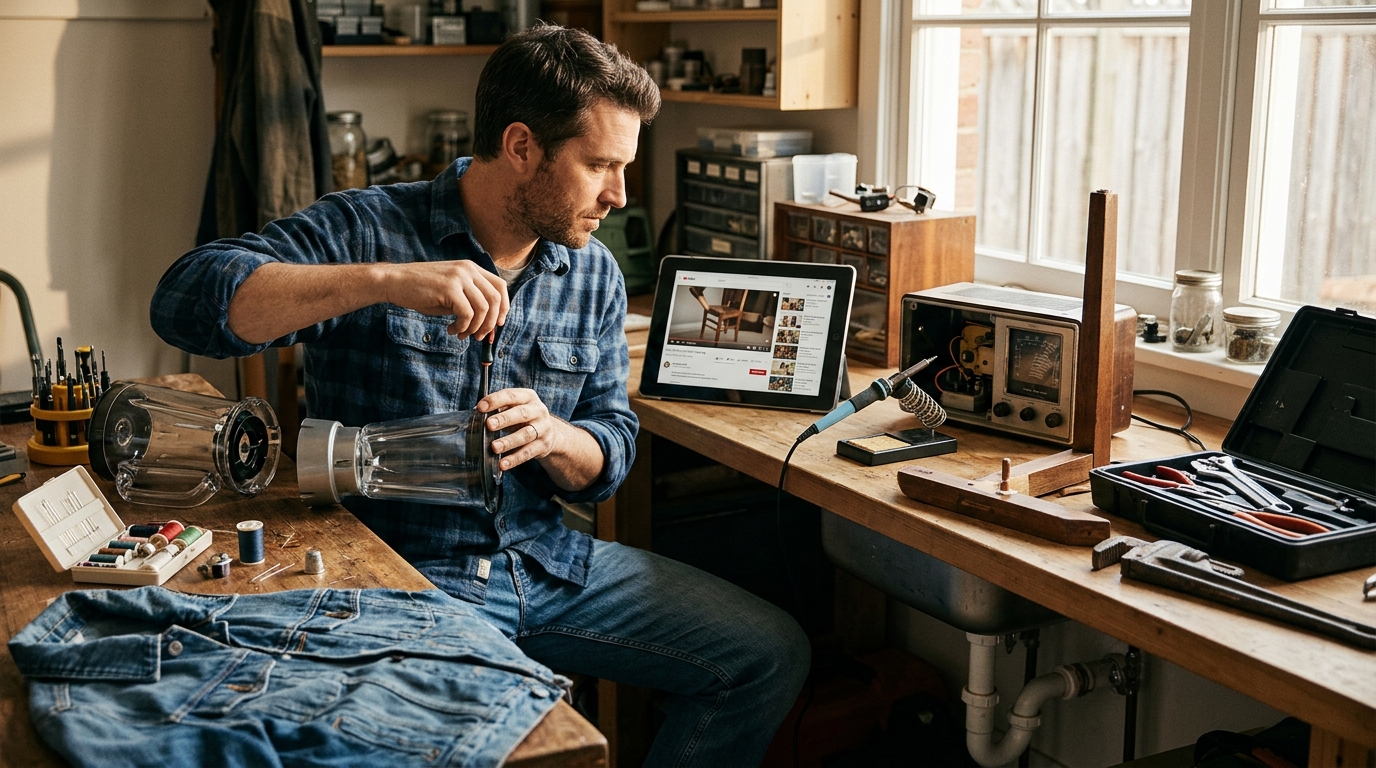
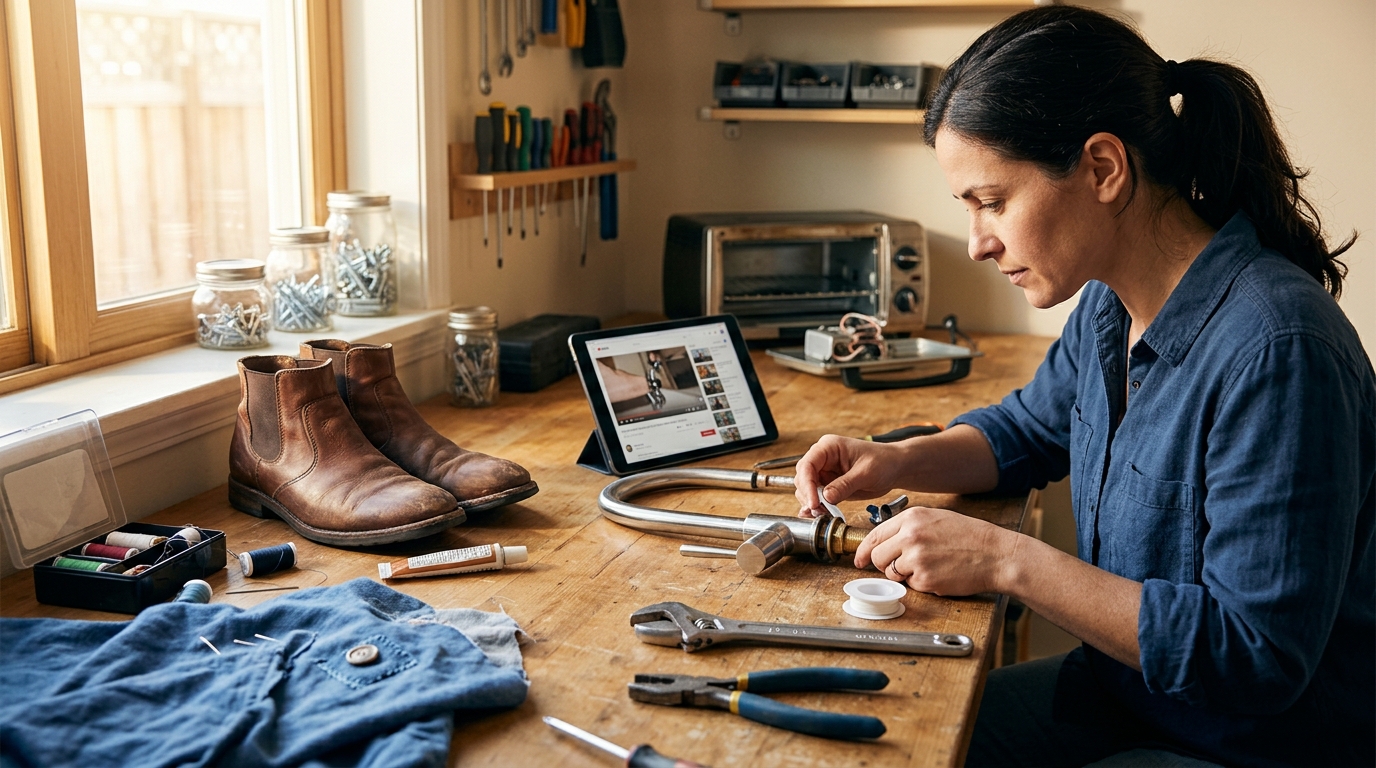
Most of my $2,000 in savings came from a short list of categories: small appliances, clothing and shoes, furniture, electronics, and minor plumbing. None of these require special expertise. They mostly require patience, the right tool for the moment, and the willingness to watch a ten-minute video twice.
Clothing and fabric. This is the fastest win for almost anyone. A torn seam, a loose button, a fraying cuff — none of it requires a sewing machine or real skill. I keep a simple basic hand-sewing kit in the kitchen junk drawer, and I probably use it once a week. My partner’s wool sweaters used to get retired after one snag; now I mend them in front of the TV. For jeans and heavier fabrics, I learned a patch-and-darn method from a single thrift-store lady’s YouTube channel, and I’ve extended the life of three pairs of pants by at least a year each.
Small electronics. Not every broken gadget can be saved, but more can than you’d think. The biggest time-saver I’ve found for accidents is a proper tool kit — I picked up an electronics repair kit after the third time a project required a screwdriver smaller than any I owned. A loose charging port on an old tablet, a cracked battery door on a wireless mouse, a stuck button on a game controller — all of these took under an hour to fix once I stopped avoiding the tiny screws.
Shoes. A pair of leather boots with a worn-out heel used to go straight into the donate pile. Now I either take them to a cobbler (twenty dollars, twenty minutes) or, for minor stuff, handle it myself with a flexible shoe adhesive. Saved two pairs of sneakers last year whose soles had started to split. The repairs aren’t invisible, but the shoes last another full season.
Furniture. Squeaky chairs, wobbly table legs, drawers that won’t close — most of this is a tightening job, and every single chair in our dining room has been revived by nothing fancier than a Phillips-head and a small bottle of wood glue. When a gouge showed up on our hardwood coffee table, I mixed wood filler with stain and you’d never find the spot now.
Knowing When to DIY vs. Call a Pro
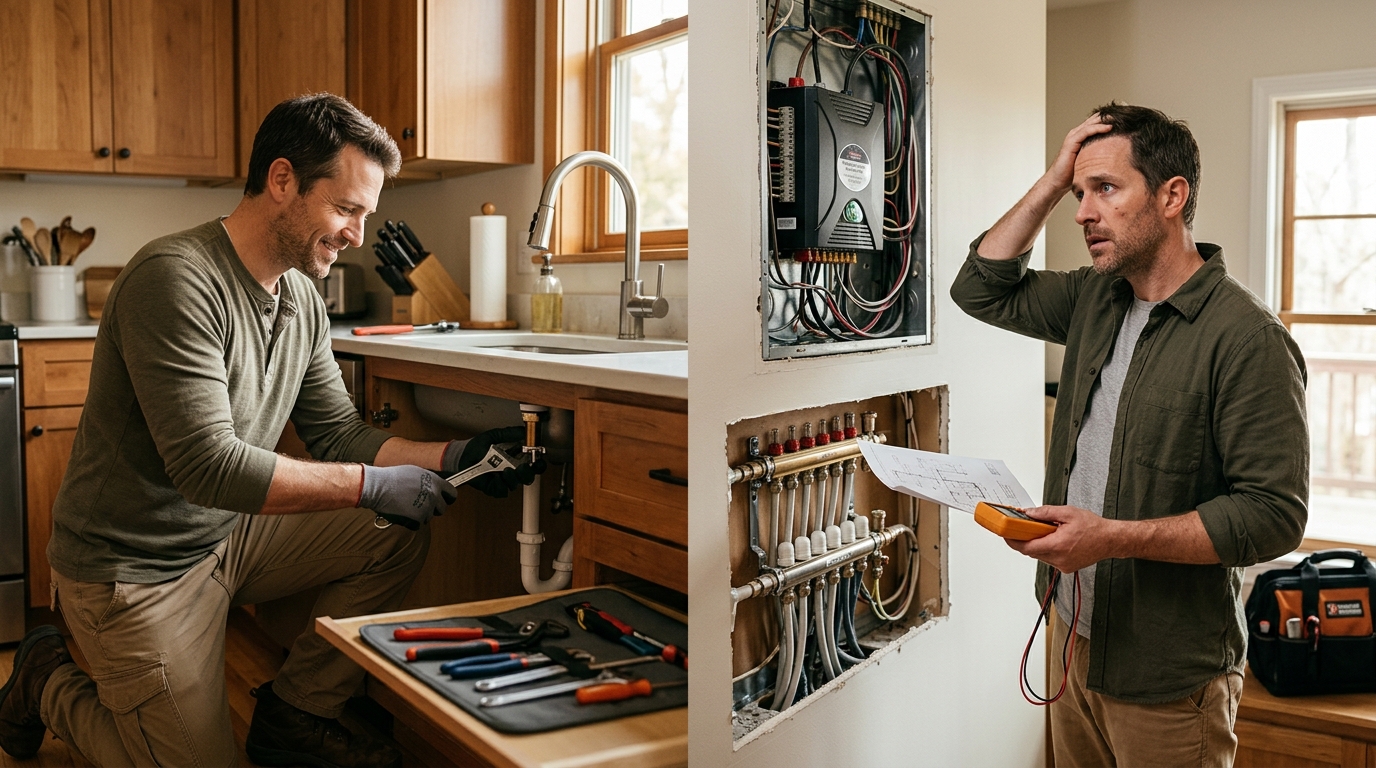
The single most valuable lesson I learned this year wasn’t a repair technique — it was a filter for deciding when not to repair something myself. The gap between “I saved $200” and “I turned a $200 problem into a $900 disaster” is sometimes one bad decision made at 10pm on a Sunday.
My rules, refined after a year:
- DIY if: the repair is mechanical, visible, reversible, and involves no pressurized water, gas, or 120V+ wiring behind the wall.
- Call a pro if: warranty is still active, the item is expensive enough that a botched fix voids resale, or the failure mode is ambiguous.
- Pause and research further if: you can’t explain to yourself, out loud, what the failure actually is.
That last one is the rule I violated the most in my first months. I’d see a symptom — water pooling under the fridge, say — and start pulling the thing apart without understanding what was actually broken. The issue turned out to be a frozen defrost drain, a ten-dollar fix, but I didn’t know that until after I’d half-disassembled a perfectly healthy ice maker.
The general pattern I’ve noticed: appliances, furniture, clothing, and electronics are almost always worth a try. Plumbing behind walls, anything involving the breaker panel, gas connections, and roof work are almost always worth a pro. HVAC is the gray zone — I’ll replace filters and clean coils, but I let professionals touch the refrigerant or sealed compressors.
The other thing I’ve learned to respect: a pro’s time. If I spend six hours flailing through a bathroom faucet replacement, that’s six hours I didn’t spend on work I actually get paid for. Sometimes the cheap decision is to pay the plumber.
The Small Investments That Paid for Themselves
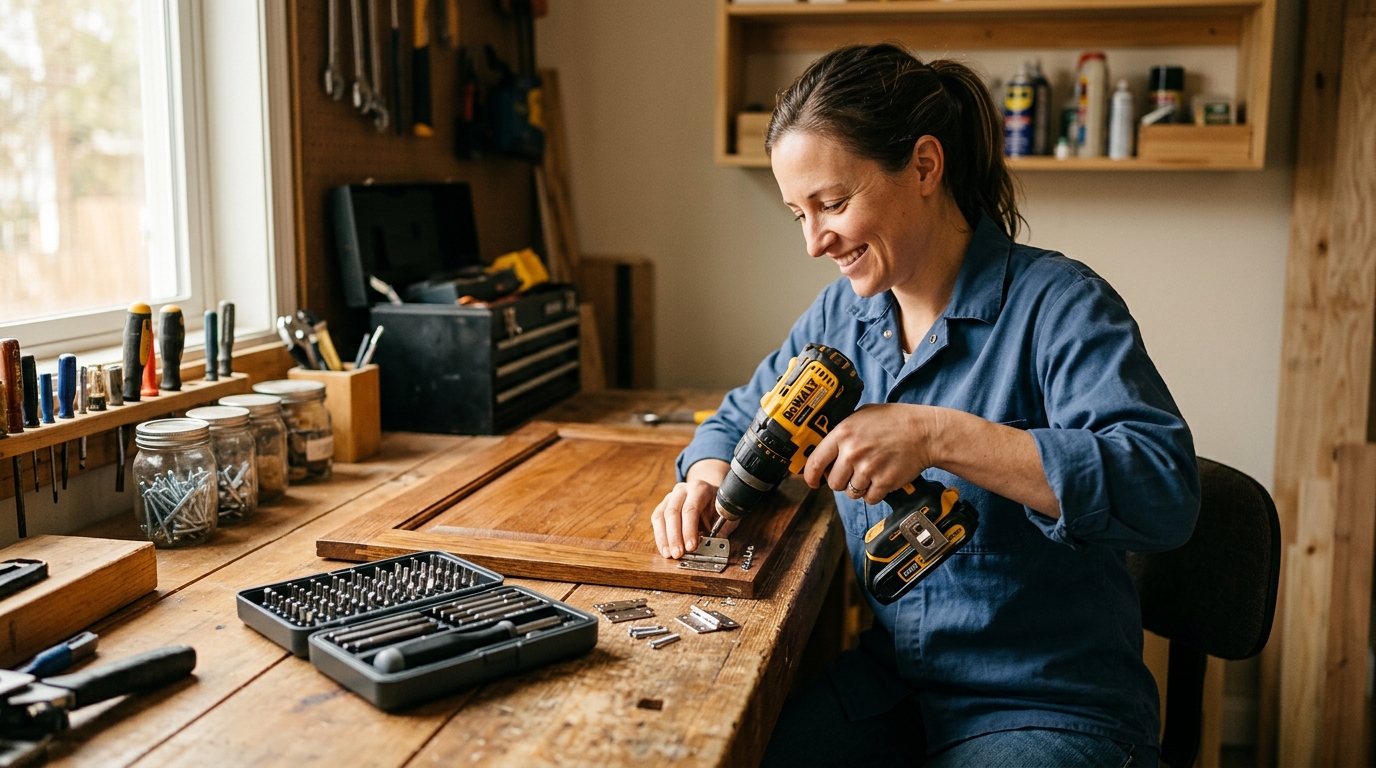
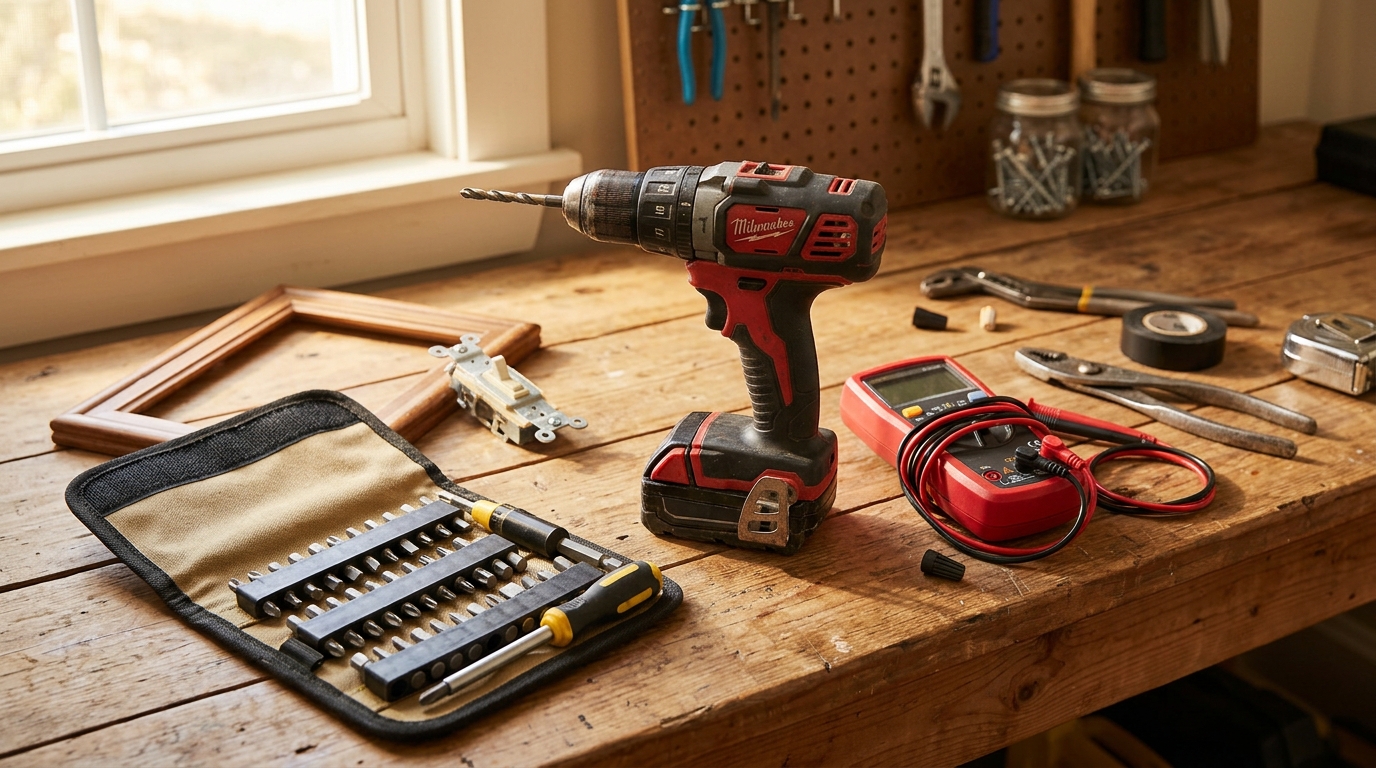
You don’t need a workshop to start. You need a short list of tools that cover a surprising range of household repairs. Here’s what I’ve ended up reaching for, in rough order of usefulness:
- A decent driver kit with interchangeable bits (Phillips, flat, Torx, hex). The single most-used tool in my house.
- A cordless drill/driver. I resisted buying one for years because I thought I didn’t need it. I was wrong by roughly 2,000%. If you own a home, you need this.
- A multimeter. Essential for diagnosing anything electrical — and they’re cheap. Twenty-dollar models are completely adequate for household use.
- A good glue shelf. Two-part epoxy for heavy bonds, cyanoacrylate (super glue) for fast small repairs, wood glue for furniture, silicone for wet areas.
- A stud finder. Saves you from drilling into pipes or live wires.
Everything else is task-specific. I’ve bought specialty tools — a pipe wrench, a bearing puller, a garment steamer — as one-off purchases when the project called for them. Almost all of them have earned back their cost within one or two uses.
The one I regret buying too late is a laser distance measure. For something I thought was an overpowered tool for occasional DIY, it turns out I use it constantly — furniture shopping, rug sizing, figuring out if the couch fits in the living room. Paid for itself on the first weekend I owned it.
Storage matters too. A parts organizer under my workbench turned “do I own that” guesses into a ten-second check. The reason most households can’t repair anything isn’t a lack of skill — it’s a lack of visible, findable supplies.
What I Fix Now That I Never Used To

A year in, the list of things I’ll attempt has grown well beyond what I’d have guessed in month one. Some of this is confidence; more of it is just the repeated discovery that most household failures are mechanical and simple.
A short, unexaggerated list of repairs I’ve actually done this year:
- Replaced a fridge water filter, and later, the water inlet valve when it started leaking.
- Rehung a kitchen cabinet door whose hinge had stripped out — a little wood glue and toothpicks in the old screw holes, then remount.
- Replaced the heating element on a clothes dryer (twenty-dollar part, thirty-minute job, saved around $180).
- Patched two drywall holes and repainted so the patches disappeared.
- Replaced the flush mechanism on a toilet that was running all night.
- Swapped the battery in an old iPhone.
- Resoldered a broken wire inside a pair of wired headphones I refused to throw out.
- Revived a squeaky office chair with a penny’s worth of silicone lubricant.
The one that surprised me most was the dryer element. I’d assumed an appliance repair that deep inside a machine would be beyond me. Three hex screws, one burnt coil, a replacement part that showed up in two days — and the dryer’s been running fine for nine months. The $180 I didn’t pay the appliance repair guy was the point where I stopped treating “inside the appliance” as a no-go zone.
The flip side: I’ve also had the humility to not repair a few things. Our old vacuum sealed its motor housing in a way I couldn’t get into without destroying it. The fix would have required specialty tools I’d never use again. I replaced it and felt fine about the decision.
Final Thoughts on the Repair Mindset

The $2,037 I saved last year is real money, and it’s the number my spreadsheet cares about. But it isn’t actually what this habit changed.
What changed is how I see my house. I used to walk through it and unconsciously keep a mental list of everything that was broken or starting to fail, a low hum of low-grade overwhelm about how much it would all cost to eventually replace. Now I walk through and that list has become a to-do list instead of a dread list. Each item is probably an afternoon and a trip to the hardware store away from being handled.
Competence is contagious inside a house. The more things you fix, the fewer things feel broken — because the definition of broken quietly shifts from “headed for the landfill” to “waiting its turn on the workbench.”
If you’re just starting out, don’t try to overhaul everything at once. Pick one broken thing you’d otherwise throw out. Spend fifteen minutes researching whether it’s fixable. Budget yourself one afternoon. If it works, you’ve saved the replacement cost. If it doesn’t, you’ve learned something and you’re back where you started, which is exactly nowhere worse than the before.
My fridge receipt is on its second year now. The number for next year isn’t the point. The point is that somewhere in the last twelve months, I stopped being a person who throws things away first and became a person who tries to fix things first. That shift, more than any single repair, is what I’d recommend to anyone.






Leave a Reply