
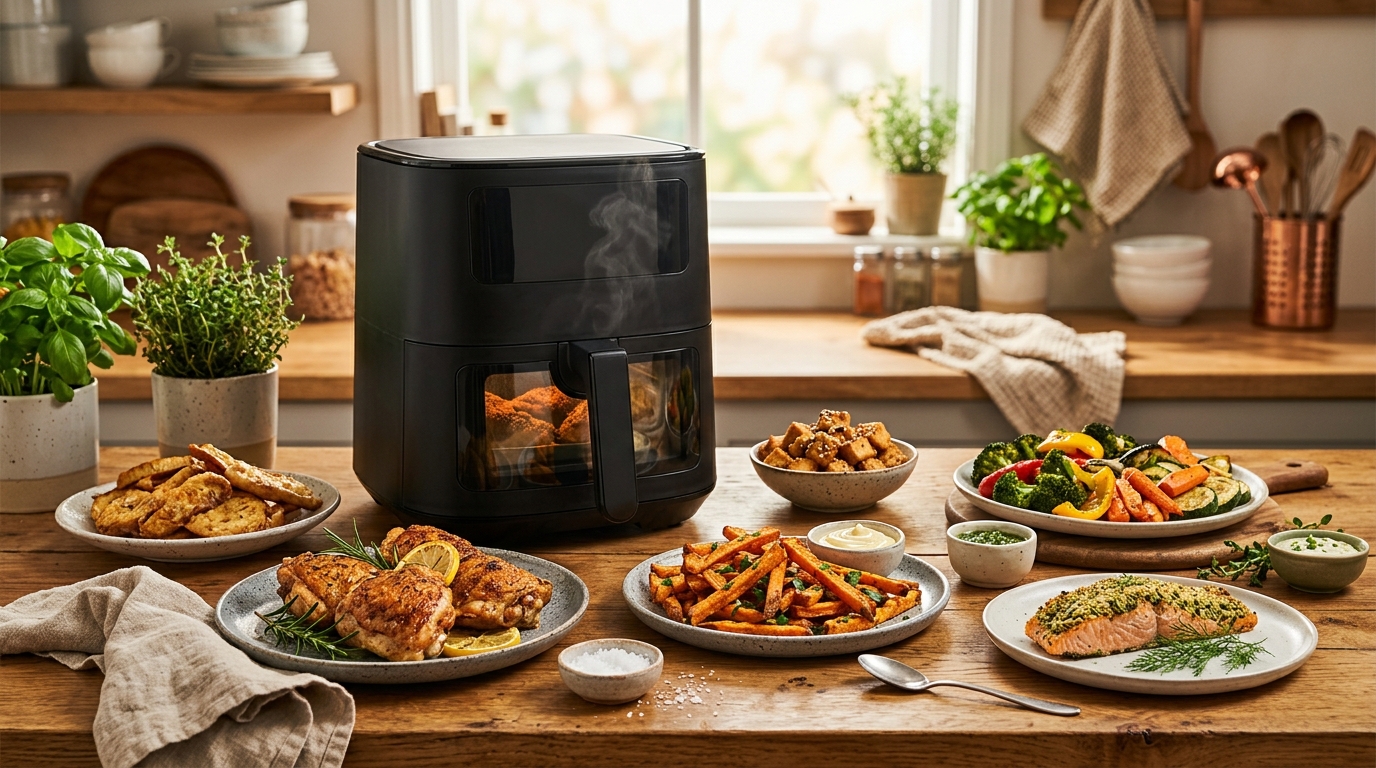
I’ll be honest with you — I used to think air fryers were a gimmick. One of those trendy kitchen gadgets you see in every Instagram ad, buy impulsively, and then shove into the back of a cabinet next to the spiralizer you’ve used exactly twice. My sister had been raving about hers for over a year, and every time she brought it up at family dinners I’d nod politely while silently judging her. Then, last February, my oven broke down mid-week and the repair quote came in at something genuinely offensive. I was staring down at least three weeks without an oven, a full refrigerator, and a family that still expected to eat real food.
So I borrowed her air fryer. Not because I believed in it — but because I had absolutely no other option.
What happened over the next thirty days completely rewired how I think about cooking. By week two, I had stopped using the repaired oven entirely. By week four, I was genuinely annoyed it had been fixed at all. The meals I was producing out of that compact little machine were faster, crispier, and honestly more satisfying than anything I’d made in my conventional oven in years. And I’ve been cooking seriously for over a decade. If it can convert a skeptic like me, it can convert anyone. Let me walk you through exactly what I made — and what made me a total believer.
The Recipe That Started Everything: Crispy Garlic Chicken Thighs
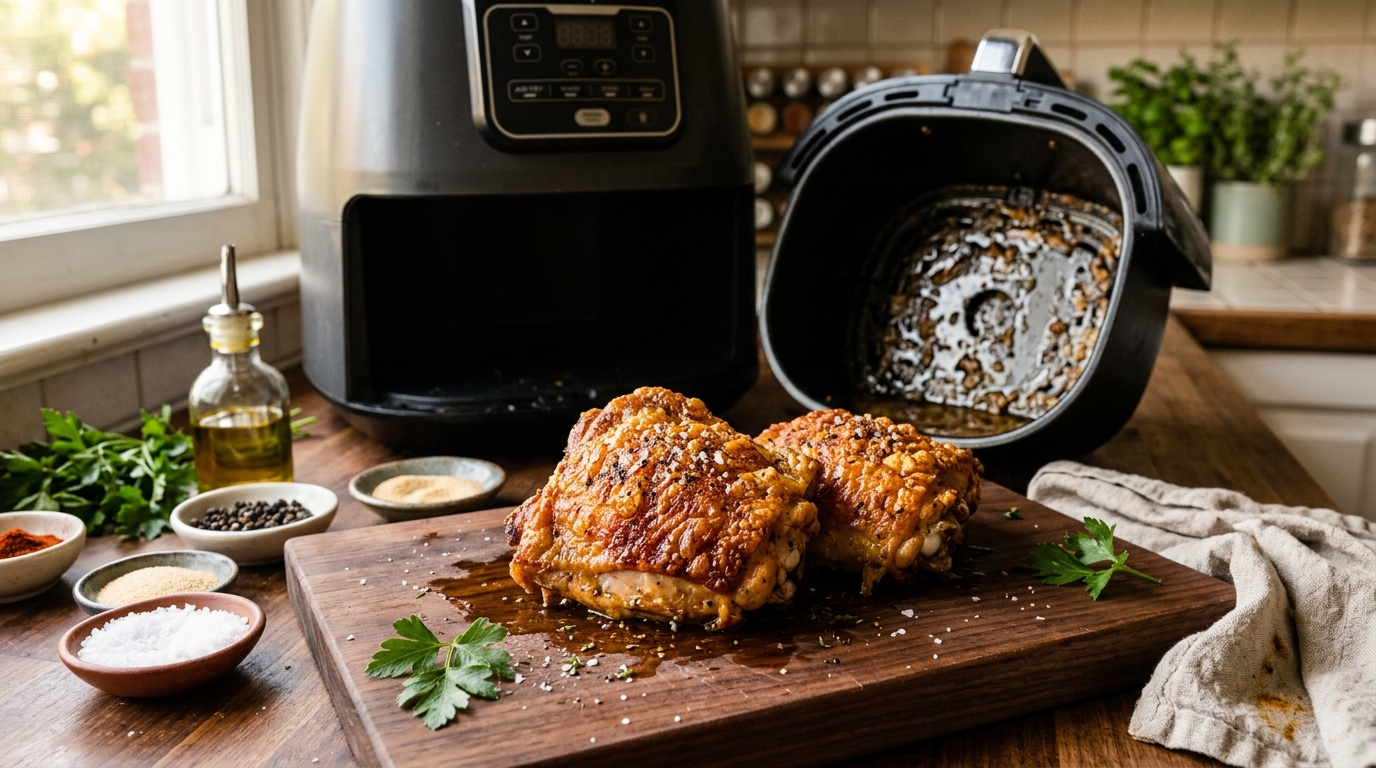
The first night with the borrowed air fryer, I kept it simple because I didn’t trust the thing yet. Bone-in, skin-on chicken thighs with olive oil, garlic powder, smoked paprika, salt, and black pepper. Rubbed them down, popped them in at 400°F for about 22 minutes, flipping once halfway through. I was fully prepared to be underwhelmed.
What I pulled out was chicken with the most crackling, golden skin I have ever produced at home. Not “pretty good for a gadget” skin. Actually crackling skin. The kind you get at a really good rotisserie spot. The inside was completely juicy — no dried-out edges, no pale undercooked patches near the bone. My partner walked into the kitchen, looked at what I was plating, and said “what did you do differently?” That was the moment I knew something had changed.
The science behind it, as I later learned, is straightforward. An air fryer circulates superheated air at high speed around the food, essentially turbocharging the convection process. Your oven does convection too if you have that setting, but nowhere near as efficiently, and it needs a much longer preheat. The air fryer I was using was ready in about three minutes. My old oven took fifteen to twenty.
After the chicken thighs, I started pushing further. Salmon fillets at 390°F for 10 minutes — beautifully flaky inside, lightly crisped outside. Pork chops that took 15 minutes and came out better than the ones I’d been pan-searing and finishing in the oven for 35. I started keeping a notes app log of times and temperatures because I wanted to understand the machine’s logic, not just follow recipes blindly. That habit alone made me a significantly better air fryer cook, faster than I expected.
If you’re just starting out, a 5-6 quart model is the sweet spot for a household of two to four people. Big enough for a full batch of chicken thighs, small enough to preheat in minutes and not dominate your counter space. Don’t let anyone sell you on a tiny 2-quart unit unless you’re cooking for one — you’ll constantly be doing two batches and losing the time advantage.
“The best tool in your kitchen is the one you actually use. Everything else is just furniture.”
By the end of that first week, the borrowed air fryer had earned permanent counter space. The oven hadn’t been turned on once. And I was only getting started.
Vegetables That Actually Taste Good: My Roasted Produce Revelation
Here’s a confession: I’ve always found roasted vegetables slightly boring when I make them at home. They come out of the oven fine — soft, acceptable, sometimes a little soggy if I crowd the pan, which I always do because I hate doing dishes. Restaurants make them taste incredible and I could never quite replicate that caramelized, slightly charred magic at home without running the oven at an aggressively high heat for a long time and inevitably setting off the smoke alarm.
The air fryer fixed all of this in one go.
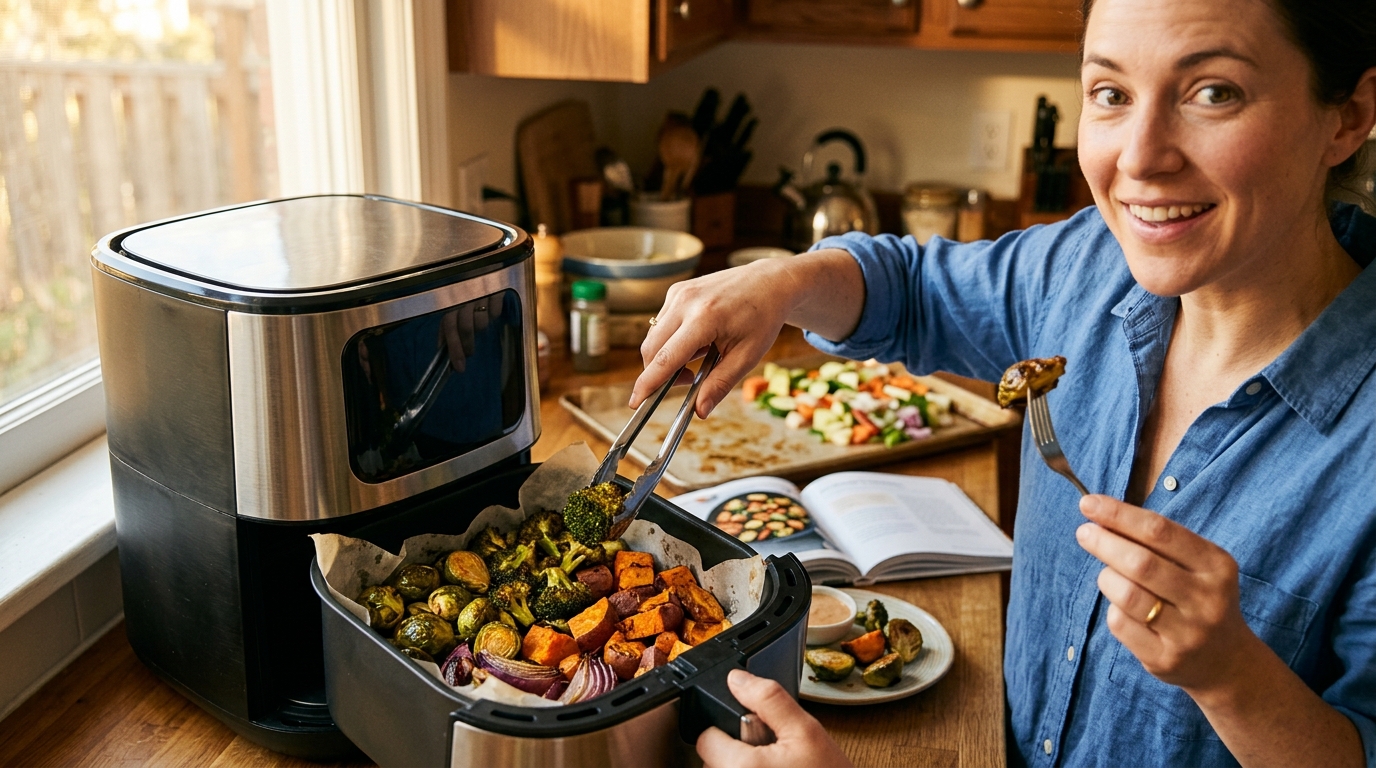
Broccoli became a completely different vegetable. Florets tossed in olive oil, salt, garlic, and a squeeze of lemon, cooked at 375°F for 12 minutes. The tips go almost crispy — not burnt, but genuinely crunchy at the edges while the stems stay tender. My kids, who have historically treated broccoli like a personal insult, started eating it without complaint. I made it four times in one week just because I could.
Brussels sprouts were the real showstopper. Halved, tossed in olive oil and a bit of balsamic, 380°F for 14 minutes with a shake at the 7-minute mark. They come out caramelized and nutty with crispy outer leaves that shatter when you bite them. I’ve served these to people who told me they hated Brussels sprouts their entire lives. Every single one of them asked for more.
The trick with vegetables, I learned through trial and error, is two things: don’t overcrowd the basket, and use slightly less oil than you think you need. Air fryers reward restraint. Too much oil and you get greasy rather than crispy. Too many vegetables jammed in and you’re steaming, not roasting. Give things room to breathe and the results are dramatic.
- Asparagus: 400°F, 7-8 minutes, toss in olive oil and parmesan
- Zucchini rounds: 380°F, 10 minutes, season with Italian herbs
- Cherry tomatoes: 375°F, 8 minutes, they burst and concentrate into something extraordinary
- Sweet potato cubes: 400°F, 15-18 minutes, toss with cinnamon and a touch of maple
- Cauliflower florets: 390°F, 14 minutes, with curry powder and a pinch of salt
I went through three bags of sweet potatoes in two weeks. My vegetable intake during this month was genuinely the highest it’s ever been as an adult — not because I was trying to eat healthier, but because the food was so good I kept wanting more of it. That is not something I ever expected to say about vegetables coming out of a machine I’d dismissed as a gimmick six months earlier.
The Snack and Side Game: Where the Air Fryer Truly Has No Competition
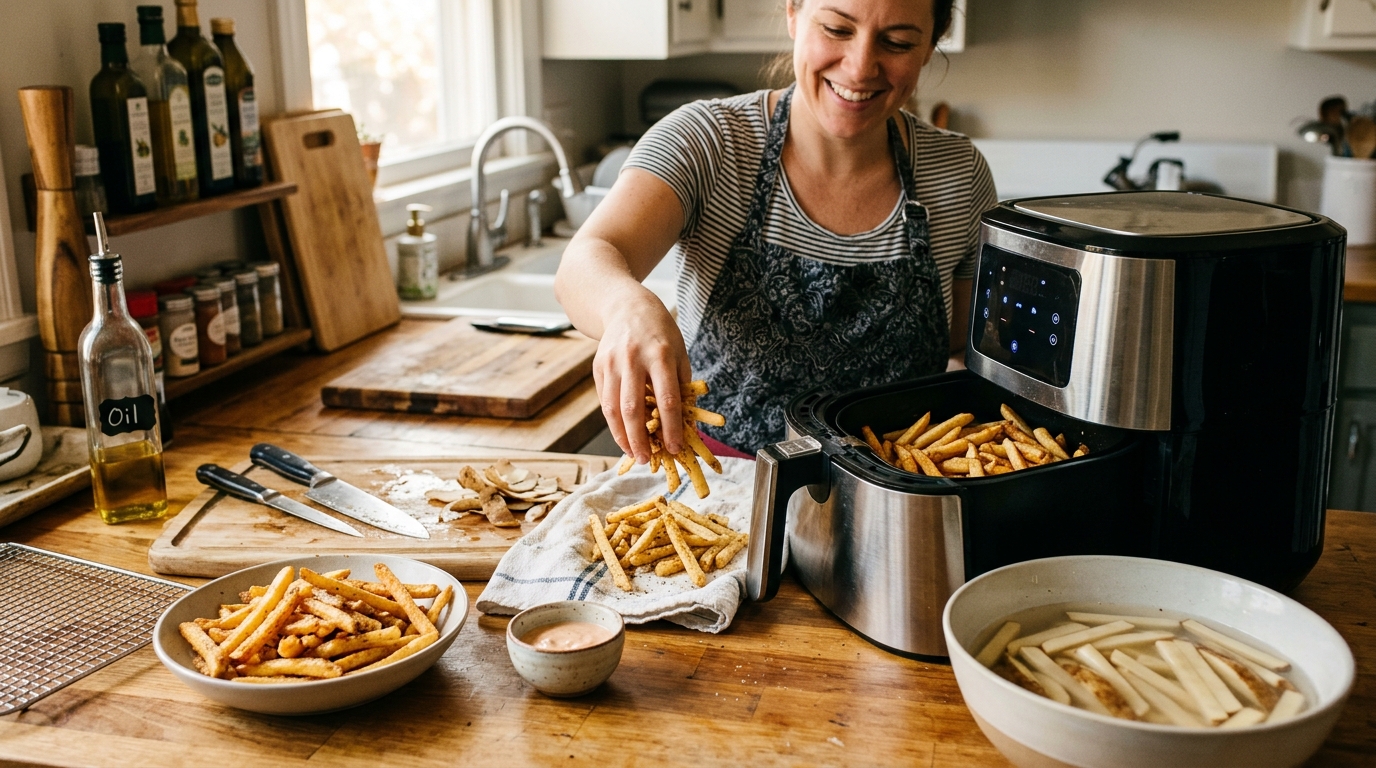
Let me tell you about the moment I made homemade French fries for the first time in years and didn’t feel like I’d spent an afternoon in a restaurant kitchen cleaning up grease splatter. That moment happened at about day ten of the air fryer experiment, and it was genuinely life-changing in the most low-stakes possible way.
Cut russet potatoes into half-inch sticks, soak in cold water for 30 minutes (this pulls out the excess starch — don’t skip it), dry them completely, toss with just one tablespoon of oil per large potato, season with salt, and cook at 380°F for 15 minutes, then crank to 400°F for another 5-8 minutes. What comes out are actual crispy fries. Not oven fries. Not sad baked potato sticks. Real fries with a crunch that holds for several minutes after plating.
Beyond fries, I started treating the air fryer as my go-to appliance for anything that needed crunch or heat restoration. Leftover pizza reheated at 350°F for 4 minutes comes out with a crispy bottom crust again — something the microwave has never once managed to accomplish. Frozen spring rolls and egg rolls: infinitely better than oven-baked, nearly indistinguishable from deep-fried. Chickpeas tossed in olive oil and spices, cooked at 390°F for 20 minutes: a crunchy, addictive snack that I now keep a jar of on the counter at all times.
For people who do a lot of batch cooking or meal prep, parchment liners designed for air fryers are worth every penny. They make cleanup nearly instant and prevent sticking without blocking airflow the way solid foil would. It sounds like a minor convenience but when you’re using the machine daily, that cleanup time adds up fast.
I also discovered that silicone baking cups open up a completely different category of air fryer cooking — individual egg bites, mini frittatas, small desserts. Suddenly the machine wasn’t just for proteins and vegetables; it was handling parts of breakfast and dessert too.
“Once you stop thinking of the air fryer as a fryer and start thinking of it as a rapid convection oven, every limitation disappears.”
By the end of week two, I had cooked more varied meals than I typically manage in a month. And I was spending less time in the kitchen, not more. That combination — variety, quality, speed — is what keeps you coming back to a cooking method. And I was coming back every single day.
Full Meals From One Basket: More Ambitious Than I Expected
Around day fifteen, I started wondering how far I could push this. Single proteins and sides were proven territory by now. But could the air fryer handle more complex, composed meals? Could I make things that felt like actual dinner — not just “food that got hot and crispy”?
The answer, it turns out, is yes. With some adaptation.
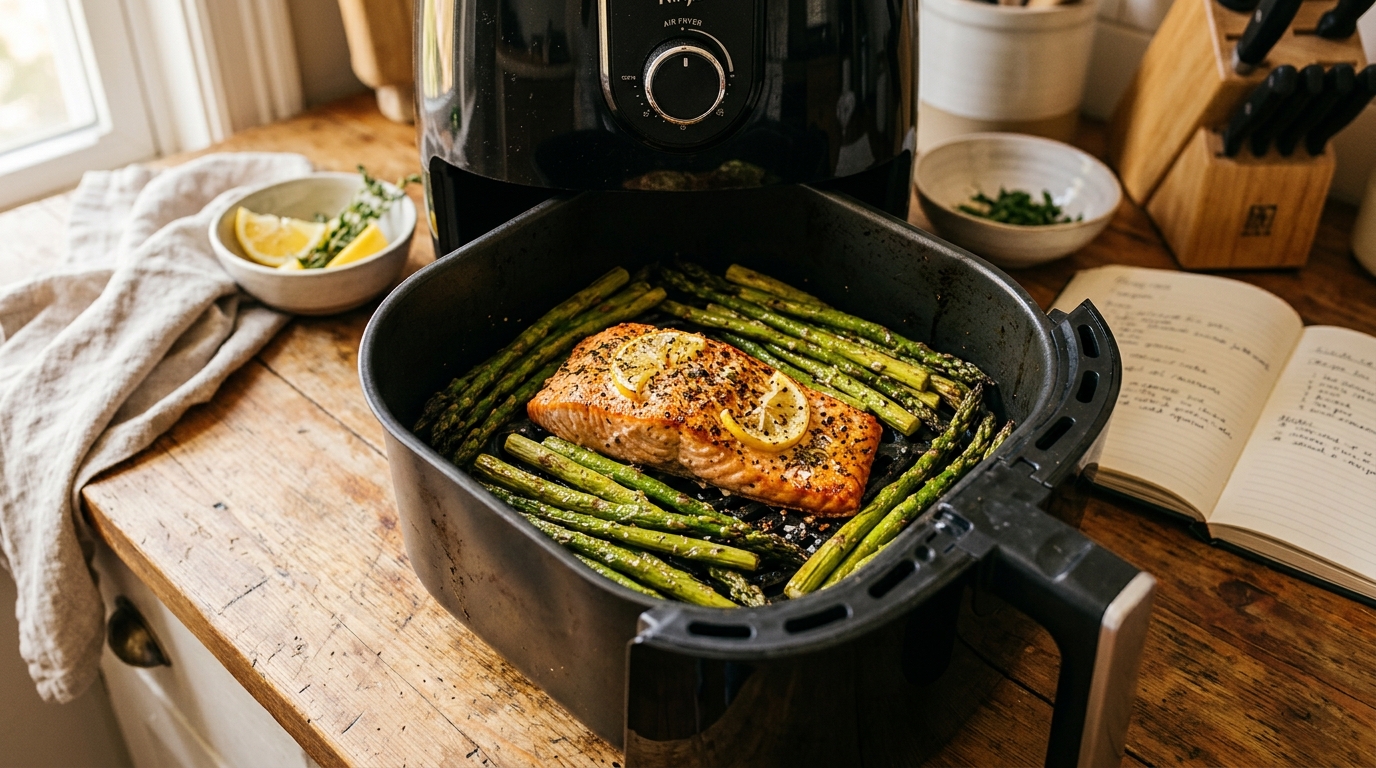
Air fryer salmon with asparagus became a weeknight staple. Season a salmon fillet, place it in the center of the basket, surround with asparagus tossed in oil, cook at 390°F for 10-12 minutes depending on thickness. Everything comes out at the same time, perfectly cooked. One basket. One wash. This is a complete, restaurant-quality dinner produced in under 15 minutes including prep, and the dishes consist of one cutting board and the air fryer basket. I made this eight times in the month. Not because I had to — because I wanted to.
Stuffed bell peppers were another revelation. Halve the peppers, fill them with a pre-cooked mixture of ground beef, rice, tomato, and spices, top with cheese, cook at 360°F for 15 minutes. The peppers soften perfectly, the filling heats through, and the cheese gets properly melted and slightly browned on top. In the oven this takes 35-40 minutes. In the air fryer it’s done in half the time and the texture is arguably better.
I even attempted a small meatloaf — shaped into individual portions, cooked at 375°F for 25 minutes. Juicy inside, slightly caramelized crust on the outside. Not something I would have even considered trying in the air fryer before this month. Now it’s in regular rotation.
For anyone who wants to go deeper with structured recipes and technique, a dedicated air fryer cookbook is genuinely useful — not because you can’t figure things out by experimentation, but because having a solid foundation of tested recipes saves weeks of trial and error. I ended up picking one up around week three and found myself using it more than I expected, particularly for baking applications I hadn’t considered.
The air fryer also handles reheating full meals brilliantly. Day-old pasta bakes, leftover casseroles, slices of frittata — things that go gummy or rubbery in the microwave come back to life in the air fryer in 5-6 minutes. This alone is worth the counter space.
The Baking Experiments: Where I Got Humbled (and Then Surprised)
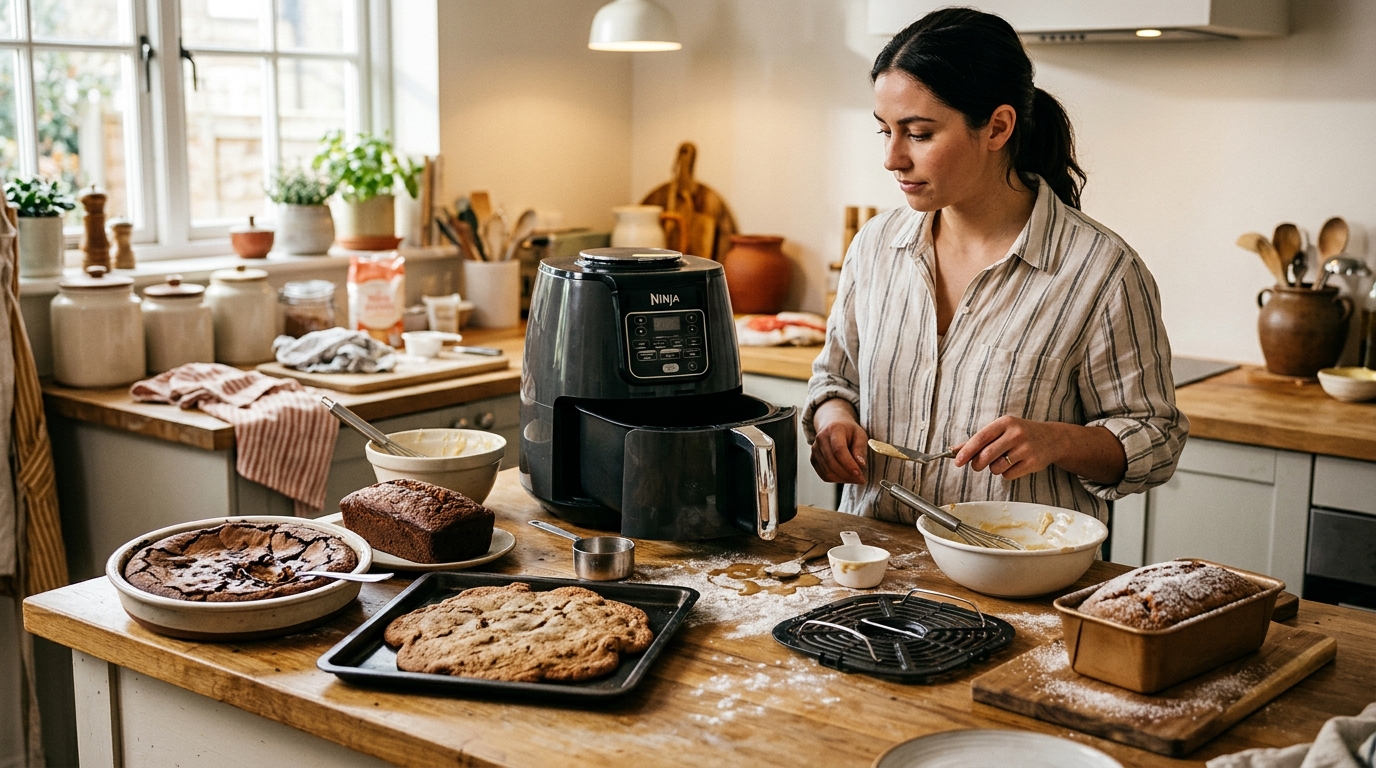
I want to be upfront with you: baking in an air fryer is real, but it requires more adjustment than anything else I tried during this month. The learning curve is steeper, and a few of my early attempts were legitimately bad. Brownies that were overbaked on top and still liquid in the center. Cookies that spread too fast and merged into one giant flat disc. A banana bread that was somehow both dense and dry simultaneously.
But here’s the thing — once I understood what the machine needed from me, the results became genuinely impressive.
The core adjustment: reduce your standard oven temperature by 25°F and reduce cooking time by about 20%. Then check early, every time. Air fryers run hotter and more efficiently than conventional ovens, and what seems like a small temperature difference translates into significant overbaking if you’re not paying attention in the early rounds.
Once I recalibrated, chocolate chip cookies at 320°F for 8 minutes came out with that slightly underdone center that crisps up as they cool — the gold standard cookie texture. Mini cheesecakes in silicone cups at 300°F for 18 minutes: silky and perfectly set. Even a simple sponge cake, made in a 6-inch round pan that fit just inside the basket, came out with a proper rise and a springy crumb that surprised me genuinely.
The limitation with baking is volume — you’re working small. A full sheet of cookies is not happening. A standard 9×13 pan is obviously not going in there. But for small-batch baking, for moments when you want four cookies and not four dozen, the air fryer is actually perfect. It heats up in three minutes, bakes fast, and you’re not heating a full oven for a single snack.
Having a small accessories kit with baking pans and racks sized for your specific air fryer model makes a significant difference here. The right pan size means even heat distribution and proper browning. The wrong pan — one that’s too large and restricts airflow, or too small and doesn’t provide structural support — is often the difference between a successful air fryer bake and a frustrating one.
I’m not going to claim the air fryer replaced my oven for baking entirely. For a full layer cake or a large batch of anything, you want the oven. But for weeknight small-batch baking, weekend treats, and those moments when you want something sweet without the full oven commitment? It’s genuinely capable.
What I’d Do Differently — And Why I’m Never Going Back
A full month in, I sat down and thought about what I’d learned. Not just the recipes and the temperatures, but the bigger lesson underneath all of it.
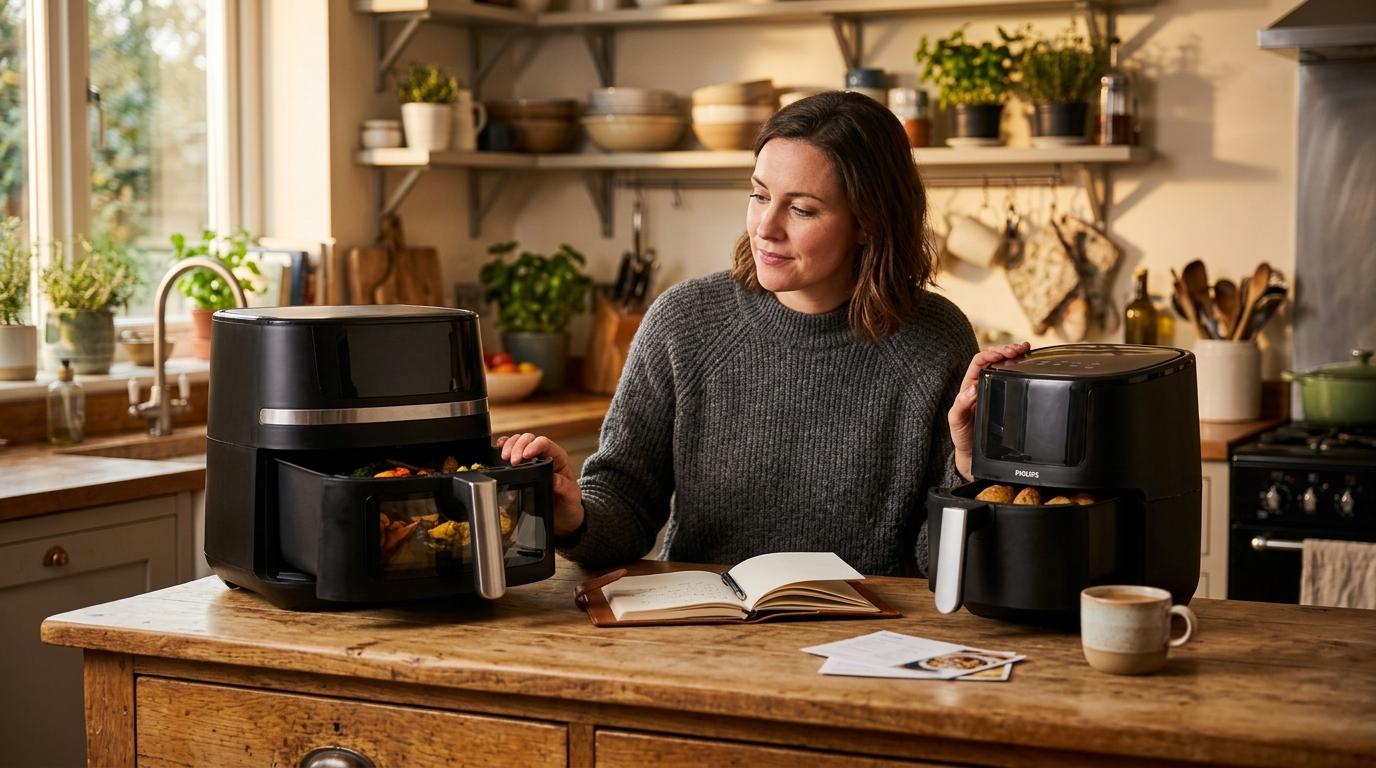
What I’d do differently if I were starting over: I’d buy a slightly larger model from the beginning. The 5.8-quart unit I eventually purchased for myself after returning my sister’s is the right call for a family of four, but there were moments during the experiment when I wished for just a bit more basket space. For larger households, or anyone who regularly cooks for guests, a 9-quart or dual-basket model is worth the larger footprint. Being able to cook proteins and sides simultaneously, in separate compartments, without any flavor transfer — that changes the whole meal prep equation.
I’d also invest in the accessories earlier. The parchment liners, the baking pans, the silicone cups — these unlocked categories of cooking I didn’t have access to with just the bare basket. They’re not expensive. They matter more than I initially assumed.
What I wouldn’t change: the complete willingness to experiment. The air fryer rewards curiosity. Every time I tried something I wasn’t sure about — the meatloaf, the stuffed peppers, the small-batch brownies — I either succeeded and had something new in my rotation, or I learned something specific about how the machine works. There’s almost no such thing as a wasted attempt because the cook time is so short. A failed 12-minute experiment is still just 12 minutes.
The oven is back in service in my kitchen. I use it occasionally — for large roasts, full sheet pans of vegetables for a crowd, baking a proper loaf of bread. But my daily cooking, my weeknight meals, my snacks and sides and reheated leftovers — all of that now runs through the air fryer. Not out of novelty or stubbornness, but because the results are consistently better and the process is consistently faster.
If you’ve been skeptical, I completely understand. I was right there with you. But if you have the slightest curiosity, even a borrowed machine for a week, I’d encourage you to give it real effort. Try the chicken thighs. Roast some broccoli. Make fries on a Tuesday just because you can. You might find, like I did, that the gadget you dismissed is actually the tool that changes how you cook entirely.
The month that started as a broken oven emergency turned into the most significant shift in my cooking habits in years. I didn’t set out to become an air fryer convert. But here I am — and I’m not going back.





Leave a Reply