
I wasn’t supposed to end up in Pattaya. My original plan had me skipping straight from Bangkok to the islands down south, because — let’s be honest — Pattaya’s reputation precedes it. Every travel forum I’d scrolled through painted the same picture: neon lights, go-go bars, and sunburned tourists stumbling down Walking Street at 2 AM. Not exactly the Thailand I was chasing.

Pattaya, Thailand
Famous for: Walking Street, beaches, Nong Nooch Garden, Sanctuary of Truth, water sports, Coral Island
But a canceled ferry and a cheap last-minute bus ticket changed everything. Five days later, I left Pattaya genuinely surprised. Behind the neon curtain, I found one of the most jaw-dropping wooden temples in Southeast Asia, an island with water clearer than anything I’d seen in Koh Samui, and a Thai cooking class where a grandmother taught me to make pad kra pao that still haunts my dreams. Pattaya is loud, messy, and unapologetic — but it’s also deeply fascinating if you’re willing to look past the obvious.
This is the itinerary I wish I’d had before I arrived. Five days, zero judgment, and a whole lot of unexpected beauty.
Day 1 — Walking Street, Bali Hai Pier, and Getting Your Bearings

I landed at U-Tapao airport after finding cheap flights to Pattaya from Bangkok’s Don Mueang — a 55-minute hop that saved me three hours on a bus. A taxi from the airport to central Pattaya cost around 350 baht, and within an hour I was checking into my room near Second Road.
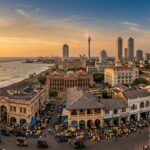
My first afternoon was all about orientation. I walked south along Beach Road, where the promenade stretches for three kilometers with vendors selling mango sticky rice and fresh coconuts. The water isn’t Pattaya’s strong suit — the bay is busy with speedboats and ferries — but the energy along the waterfront is infectious. Street performers, families, backpackers, and retirees all share the same sidewalk, and there’s a strange democracy to the chaos.
Bali Hai Pier is the real starting point. Perched at the southern tip of Pattaya Bay, the pier offers a panoramic view of the entire coastline. I climbed the hill behind it — pratumnak hill — just before sunset and watched the city light up like a circuit board. The viewpoint up there is free, uncrowded, and absolutely worth the sweaty ten-minute climb.
After dark, I did what everyone does on their first night: Walking Street. I’ll say this — it’s not for everyone, and it’s exactly what you’ve heard. But experiencing it once is part of understanding Pattaya. I joined a street food tour that reframed the whole strip through its food stalls rather than its bars. We ate grilled squid, papaya salad, and these tiny coconut pancakes called khanom krok that I became obsessed with for the rest of the trip.
The key insight from Day 1: Pattaya rewards you for going one block deeper. Walking Street is the surface layer. The sois (side streets) behind it hold family-run restaurants, tiny temples, and locals living their lives completely unbothered by the circus a hundred meters away. I made a mental note to keep exploring those back streets, and it paid off every single day that followed.
Day 2 — The Sanctuary of Truth, Naklua, and the Best Seafood of My Life

Day 2 started early, and it started with what became the single most impressive thing I saw in all of Pattaya: the Sanctuary of Truth. I’d booked skip-the-line tickets for the Sanctuary of Truth the night before, and I’m glad I did — by 10 AM the entrance queue was already long.
Nothing prepares you for this building. It’s a 105-meter-tall wooden structure jutting out over the ocean, entirely covered in hand-carved Hindu and Buddhist mythology. Every surface — every beam, every column, every ceiling panel — is a swirl of gods, nagas, and celestial beings carved from teak and ironwood. No nails hold it together. The whole thing is assembled with wooden pegs and joints, and it’s been under continuous construction since 1981. Workers were still carving when I visited, suspended on bamboo scaffolding high above the ground.
“We will never finish,” our guide said with a smile. “That is the point. Truth is always being built.”
I spent nearly two hours there, which is more than most visitors, but I couldn’t stop finding new details. The ocean breeze through the open walls, the sound of chisels echoing through the halls — it felt more like a living art installation than a tourist attraction.
From the Sanctuary, I grabbed a songthaew (the shared pickup-truck taxis that are Pattaya’s public transport) north into Naklua. This neighborhood is the anti-Walking Street: quiet, local, and centered around a fish market that stretches along the waterfront. I asked around at seafood restaurants in Naklua and ended up at a family-run place where I pointed at live prawns in a tank and they grilled them with garlic and glass noodles in a clay pot. The bill came to 280 baht — about eight dollars for a meal I’d pay sixty for back home.
Naklua is where Pattaya feels most like a real Thai town. The temples here are modest and genuine, the street food vendors don’t have English menus, and the beach — while narrow — is calm and nearly empty on weekday mornings. If I were to return, I’d stay in Naklua without question. It’s only fifteen minutes from central Pattaya but feels like a different city entirely.
Day 3 — Koh Larn: Pattaya’s Secret Island Paradise

Everyone told me to do Koh Larn, and for once, everyone was right. I booked a day trip to Koh Larn that included speedboat transfer, lunch, and time at two different beaches — and it was the best money I spent in Pattaya.
The speedboat took about twenty minutes from Bali Hai Pier. The moment we rounded the island’s northern tip and I saw that turquoise water, I actually laughed out loud. This is seven kilometers from Pattaya. Seven. The water goes from murky bay gray to crystalline Caribbean blue in the span of a short boat ride. It felt like a magic trick.
We stopped first at Tawaen Beach, which is the busiest of Koh Larn’s beaches. Busy here means maybe a hundred people spread across a wide crescent of white sand — compared to Pattaya Beach, it felt deserted. I rented a beach chair for 50 baht, swam in water so clear I could see fish darting around my feet, and ate pineapple fried rice from a beachside vendor who’d been setting up her stall at the same spot for twenty-three years.
The real gem is Samae Beach on the island’s west side. Our boat took us around, and this beach was quieter, with softer sand and better snorkeling along the rocky edges. I saw parrotfish, clownfish, and a massive sea urchin that I gave a very respectful distance. The water visibility was easily ten meters.
If you go independently — which is totally doable via the public ferry for 30 baht each way — rent a motorbike on the island for 300 baht and explore all six beaches at your own pace. The island has a small interior village with temples, cats sleeping on warm concrete, and a 7-Eleven that somehow exists on even the smallest Thai islands.
I got back to Pattaya sunburned and salty around 5 PM, showered at the hotel, and spent the evening wandering the night market near Central Festival mall. I picked up handmade soap, a pair of elephant-print fisherman pants I’ll never wear at home, and a bag of dried mango that was gone before I reached my room. The night markets here are smaller than Bangkok’s but less overwhelming — you can actually browse without being swept along by a crowd.
Koh Larn alone justifies a trip to Pattaya. If you only have one day and someone asks what to do, send them to that island. No hesitation.
Day 4 — Nong Nooch, Floating Markets, and Learning to Cook Thai

Day 4 was my big excursion day, and I packed it full. First stop: Nong Nooch Tropical Garden, about twenty minutes south of central Pattaya. I grabbed tickets to Nong Nooch that included the cultural show, and arrived right when the gates opened at 8 AM.
Nong Nooch is enormous — 600 acres of themed gardens, dinosaur sculptures, elephant shows, and a cultural performance that includes traditional Thai boxing and dance. The French-inspired topiary garden is surreal: perfectly manicured hedges shaped into geometric patterns, stretching across a hillside that looks like it was transplanted from Versailles and then given a tropical makeover. The orchid garden is spectacular too, with varieties I’d never seen — some so tiny they fit on a fingertip, others with petals the size of my hand.
I’ll be honest: Nong Nooch is a bit of a sensory overload. There’s a lot happening, and some of it is kitsch. But the gardens themselves are genuinely world-class, and the Thai cultural show is well-produced and respectful. Budget at least three hours.
After Nong Nooch, I stopped at the Pattaya Floating Market on Sukhumvit Road. It’s a touristy recreation of a traditional floating market — wooden walkways over canals, vendors in boats selling food and crafts. Is it authentic? Not really. Is it fun? Absolutely. I ate boat noodles served from an actual boat, bought a coconut ice cream in a coconut shell, and watched a woman weave silk on a loom balanced on a narrow longboat. It’s a pleasant hour-long stop, especially if you’ve never seen a floating market before.
The highlight of Day 4, though, was the evening. I’d signed up for a Thai cooking class at a small family home near Jomtien, and it turned out to be one of those perfect travel experiences you can’t plan for. The instructor — a grandmother named Khun Noi — taught four of us how to make tom yum goong, green curry, and mango sticky rice from scratch. We shopped for ingredients at a local wet market, pounded curry paste with a stone mortar, and sat on the floor to eat everything we’d made while Khun Noi’s grandkids played in the next room. It was the most “real Thailand” moment of my entire trip.
Day 5 — Jomtien Beach, Last Bites, and Getting Out of Pattaya

I saved my final day for Jomtien, the long beach strip south of Pattaya that draws a calmer, more relaxed crowd. I’d booked a beachfront hotel near Jomtien for my last night specifically so I could wake up to the ocean — and it was worth every baht. Jomtien Beach is wider, cleaner, and quieter than Pattaya Beach, with better swimming conditions and a boardwalk lined with seafood restaurants.
I spent the morning doing absolutely nothing. Beach chair, cold Chang beer, a paperback novel, and the sound of waves. After four days of temples, islands, and cooking classes, the laziness felt earned. Around noon, I rented a stand-up paddleboard from a beach vendor for 200 baht per hour and wobbled my way along the coastline. The water is calm enough here for beginners, and the views back toward Pattaya’s skyline from the water are surprisingly beautiful.
For my final lunch, I walked to a place on Jomtien Soi 5 that served khao pad pu — crab fried rice — that was so good I ordered a second plate. Simple, cheap, perfect. The best food in Pattaya is never in the places with English menus and photos outside. It’s always down the soi, behind a plastic curtain, with a fan blowing steam from a wok.
Getting out of Pattaya is easy. I took the bus back to Bangkok from the North Pattaya bus terminal — a comfortable, air-conditioned coach that costs about 120 baht and takes two hours. Buses leave every thirty minutes, so there’s no need to book ahead unless it’s a holiday weekend. If you’re heading to the islands, minivans run direct to Rayong and Trat, connecting to ferries for Koh Samet and Koh Chang.
One thing I wish I’d done: visited the Big Buddha Hill (Wat Phra Yai) on the way out. The eighteen-meter golden Buddha sits on a hill between Pattaya and Jomtien, and apparently the view from up there rivals Pratumnak Hill. Next time — and I’m surprised to say there will be a next time.
As the bus pulled onto the motorway, I watched Pattaya’s high-rises shrink in the window and thought about how wrong my assumptions had been. This city has layers. You just have to peel them back.
Practical Tips — Budget, Transport, and When to Visit Pattaya

Best time to visit: November through February is the sweet spot — dry, sunny, and slightly cooler. March and April are brutally hot. The rainy season (June to October) brings afternoon downpours but also fewer crowds and lower prices. I visited in early December and the weather was flawless.
Budget breakdown for 5 days:
- Accommodation: 800–2,500 baht/night depending on comfort level
- Food: 300–600 baht/day eating at local spots
- Transport (songthaews, motorbike taxis): 200–400 baht/day
- Activities and entrance fees: 2,000–4,000 baht total
- Total realistic budget: 15,000–25,000 baht (roughly $430–$720 USD) for 5 days
Getting around: Songthaews are king. These shared pickup trucks run fixed routes along Beach Road, Second Road, and to Jomtien for 10–20 baht per ride. For more flexibility, consider renting a car — useful for reaching Nong Nooch, the vineyards east of town, or exploring the coast at your own pace. Motorbike rentals are everywhere (250–350 baht/day) but traffic is chaotic, so ride carefully.
Where to stay:
- Central Pattaya / Second Road: Best for first-timers who want walkable access to everything
- Naklua: Best for food lovers and travelers who prefer quiet neighborhoods
- Jomtien: Best for beach time, families, and long-stay visitors
- Pratumnak Hill: Best for couples and boutique hotel vibes
Safety: Pattaya is generally safe for tourists. Standard Southeast Asia precautions apply — watch your belongings in crowded areas, negotiate prices before getting in tuk-tuks, and avoid jet ski rental scams on the main beach (a well-documented issue). Stick to reputable operators for water sports. If you want curated experiences with vetted guides, browsing top-rated activities on TripAdvisor is a solid way to filter out the scams from the gems.
If you’re considering a broader Thailand itinerary, a multi-day Thailand tour that includes Pattaya alongside Bangkok and Kanchanaburi gives you the best of urban, coastal, and historical Thailand in one trip. It’s an efficient way to see the country if your time is limited.
- Book the Sanctuary of Truth first thing — it’s the one must-do in Pattaya
- Spend a full day on Koh Larn, not a half-day
- Eat in Naklua at least once
- Don’t skip Jomtien — it’s the beach Pattaya wishes it had
- Give Walking Street one night, then move on
Pattaya surprised me. It won’t be everyone’s favorite Thai destination — it’s too brash, too loud, too contradictory for that. But for five days, it gave me ancient temples, island water that glowed blue, street food that cost less than a dollar, and a grandmother who taught me to cook green curry while her grandchildren drew pictures at the kitchen table. That’s more than enough. Sometimes the places with the worst reputations have the best stories hiding inside them.





Leave a Reply