
5 Days in Doha — Desert Dunes, Futuristic Skylines, and Qatar’s Rising Star
I almost didn’t book the trip. Qatar had been on my radar for years — one of those destinations that felt perpetually “next time” — until a last-minute deal on a round-trip fare from New York made the decision for me. Within forty-eight hours I had a five-night stay booked and a rough itinerary scratched onto a notepad. What I found when I landed at Hamad International Airport was something I hadn’t fully anticipated: a city that holds the ancient and the astronomical in the same palm. Souqs that smell of oud and cardamom sit in the shadow of towers sheathed in glass and ambition. The desert begins almost where the pavement ends. And the food — the food alone justified every hour of the flight.

Doha, Qatar
Famous for: Museum of Islamic Art, Souq Waqif, The Pearl-Qatar, Katara Cultural Village, desert safaris
Qatar is a small country, roughly the size of Connecticut, but it punches far above its weight in terms of what a traveler can pack into a short visit. Doha is the undisputed center of gravity, and five days is just enough time to scratch beneath the polished surface and find something genuine underneath. Below is how I spent those five days, what surprised me, what I’d skip, and the practical advice I wish someone had handed me at the airport.
Day 1 — Souq Waqif, the Museum of Islamic Art, and the Corniche at Dusk

My first full day set the tone for everything that followed. I had deliberately kept it slow — no grand ambitions, just the old city and the waterfront. Souq Waqif is the obvious starting point for any first-timer, and the crowds are there for a reason. The labyrinthine lanes are genuinely disorienting in the best possible way. Spice vendors stack pyramids of saffron and za’atar beside stalls selling hand-embroidered thobes and silver Bedouin jewelry. Falcons — living, hooded, gorgeous — perch on wooden stands outside the falcon souq, available for purchase if you happen to need one.
I spent close to two hours wandering before settling at a small Qatari café tucked into a shaded alley. A pot of karak chai and a plate of luqaimat (fried dough balls drenched in date syrup) cost me under five dollars and kept me going until lunch. For lunch itself, I’d been told to eat at one of the traditional Arabic restaurants inside the souq — I chose a spot with floor cushions and a clay oven visible from the dining room. The lamb machboos, Qatar’s unofficial national dish, arrived fragrant with dried limes and loomi.
After lunch I walked to the Museum of Islamic Art, a ten-minute stroll along the corniche. I.M. Pei designed the building, and it looks like a geometric thought experiment dropped onto its own artificial island. Inside, fourteen centuries of Islamic civilization are arranged across two floors with a clarity that never tips into sterility. The calligraphy collection alone is worth the admission. I booked a guided tour of the permanent collection which added enormous context — my guide had a background in Islamic history and answered every half-formed question I threw at her.
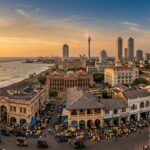
As the sun dropped toward the Gulf, I joined the evening strollers on the Corniche. The 7-kilometer waterfront promenade faces the West Bay skyline, which at golden hour looks almost impossibly cinematic — glass towers catching orange and pink light while dhows drift in the foreground. It is one of those views that photographs struggle to capture honestly. I walked most of the length before catching a taxi back to my hotel, legs pleasantly tired, already looking forward to day two.
“The Corniche at sunset is Doha’s most democratic moment — locals, expats, and tourists all sharing the same light, the same view, the same quiet satisfaction.”
Day 2 — The Pearl Qatar, Katara Cultural Village, and a Different Kind of Luxury

The Pearl Qatar is an artificial island about the size of a small European city, built on reclaimed land and designed to evoke the old Mediterranean port towns of Portofino or Monaco. It succeeds more than skeptics give it credit for. The marina at Porto Arabia is legitimately beautiful — super yachts bobbing in glassy water, pastel facades lining the promenade, and a density of excellent restaurants that would shame neighborhoods in London or Dubai.
I spent the morning walking the island’s perimeter, stopping at the Venetian-inspired Qanat Quartier, where canals are lined with pastel-colored buildings so convincingly Italian that I had to remind myself I was on a man-made island in the Arabian Gulf. Luxury boutiques occupy most of the ground-floor retail, but the real draw is the atmosphere. Sitting with an espresso at a waterside café while watching the morning light shift on the water is a perfectly reasonable way to spend two hours.
After The Pearl, I headed to Katara Cultural Village, a short taxi ride south. Where The Pearl is aspirational and outward-looking, Katara is deliberately rooted in Arab and Islamic heritage. It hosts an outdoor amphitheater carved from stone, several excellent galleries, a mosque with a striking blue dome, a Greek theater, and a stretch of restaurants representing cuisines from across the Arab world and beyond.
I booked a culinary walking tour of Katara that introduced me to food I would never have found on my own — a Syrian shawarma spot that hand-carves its meat to order, a Lebanese pastry shop doing extraordinary knafeh, and a Moroccan tea house where the mint tea is poured from a theatrical height. The tour guide was a Tunisian expat who had been living in Doha for twelve years and spoke about the city’s food scene with infectious enthusiasm.
- Katara is busiest on Friday and Saturday evenings — arrive in the morning for a calmer experience
- The beach at Katara is one of the few public beaches in Doha and is well maintained
- Gallery admission is generally free; check the Katara website for rotating exhibitions
- The Blue Mosque allows non-Muslim visitors outside of prayer times
I ended the day with dinner at a rooftop restaurant in The Pearl’s Porto Arabia, watching the marina lights reflect off the water below. Staying somewhere within walking distance of The Pearl makes the evening far more relaxed — no taxi logistics, no parking headaches, just a short walk back to your room.
Day 3 — Desert Safari, the Inland Sea, and Camel Rides at Khor Al Adaid

Day three was the one I had been quietly most excited about since planning the trip. Qatar’s desert interior is stunning — rolling red-gold dunes that seem to belong to an older, quieter planet — and Khor Al Adaid, known as the Inland Sea, is the geographical marvel that rewards the drive. It is the only place in the world where the sea intrudes into the desert to create an inland body of water entirely surrounded by dunes, and UNESCO has recognized it as one of the world’s rare natural phenomena.
I booked a full-day desert safari including dune bashing, camel rides, and the Inland Sea departing from central Doha at 8:00 a.m. The drive south takes about an hour before the pavement ends and the 4×4 vehicles deflate their tires for the sand. Dune bashing is exactly what it sounds like: a driver who clearly loves their job piloting a Land Cruiser up and over steep dunes at angles that make your stomach drop. It is objectively ridiculous and completely exhilarating.
The camel ride segment took place in the late morning at a small enclosure near the dunes. The camels are patient animals with deeply skeptical expressions, and riding one — even at walking pace — offers a perspective on the desert landscape that no vehicle can replicate. Dress in layers: the desert air in the morning can be surprisingly cool, and by midday the sun is relentless.
“Standing at the edge of the Inland Sea, where the dunes drop straight into turquoise water and there is nothing visible in any direction but sand and sky and sea, is one of the most disorienting and beautiful moments I have had as a traveler.”
The tour included a traditional Bedouin-style lunch at a camp near the sea — grilled meats, rice, flatbread, and unlimited sweet tea — before the drive back to Doha in the afternoon. I was back at my hotel by 5:00 p.m., sunburned and satisfied. If you have only one non-city excursion in your Doha itinerary, this is the one to prioritize.
- Book the desert safari at least two days in advance, especially in peak season (October–April)
- Wear sunscreen with SPF 50+ and bring a hat; shade at the Inland Sea is essentially nonexistent
- The dune-bashing portion is not suitable for people with back problems or those who are pregnant
- Most tours include hotel pickup and drop-off — confirm this when booking
Day 4 — National Museum of Qatar, Education City, and Aspire Zone

Day four was Doha at its most contemporary and ambitious. Qatar has invested billions into institutions designed to project the country as a global center for culture, education, and sport — and while the skeptic in me was prepared to find a lot of expensive superficiality, what I found was more interesting and more genuinely impressive than expected.
The National Museum of Qatar is worth visiting for the building alone. Jean Nouvel designed it as a series of interlocking discs inspired by the desert rose — a crystalline mineral formation found in the Qatari sands. The structure is so assertive that the first thirty minutes inside are spent simply processing the architecture. The exhibitions themselves are smart and personal: Qatar’s story is told through the voices of Qatari families, through photographs and objects and oral histories. The gallery dedicated to pearl diving — the industry that sustained Qatar before oil — is quietly moving. I gave it four hours and could have given it more.
From the museum I took a taxi to Education City, Qatar Foundation’s vast campus on the western edge of Doha. It houses branch campuses of eight international universities — Georgetown, Northwestern, Carnegie Mellon, and others — along with research centers, mosques, and striking contemporary architecture at every turn. The campus is open to visitors, and walking it gives a tangible sense of Qatar’s long-term ambitions. The Museum of Islamic Art’s sister institution, the QF Walking Tour, is available on select days and is well worth joining for the architectural context it provides.
I finished the afternoon at Aspire Zone, the sports complex built for the 2006 Asian Games and later repurposed as a public park and athletic facility. The Aspire Tower — nicknamed the Torch for its flame-shaped crown — dominates the skyline. The park grounds are large, beautifully landscaped, and popular with Doha families in the late afternoon. I jogged the perimeter path as the sun lowered and the tower lit up orange against a purple sky, feeling enormously grateful for the accidental decision that had brought me here.
- The National Museum of Qatar admission is 50 QAR (approximately $14); audio guides are available in English
- Education City is accessible by Doha Metro (Red Line, Education City station)
- Aspire Zone has a public swimming pool and several sports facilities open to non-members
- The Torch restaurant inside Aspire Tower offers panoramic views; reservations are recommended
Day 5 — Al Zubarah Fort Day Trip and a Last Look at Doha Before Departure

My final day was the most logistically involved and the most unexpectedly emotional. Al Zubarah Fort sits approximately 105 kilometers northwest of Doha on Qatar’s northwestern coast — a straightforward 90-minute drive across a landscape that gets progressively emptier and more beautiful as you leave the capital behind. The fort and surrounding archaeological site together form the UNESCO World Heritage-listed Al Zubarah Archaeological Site, the best-preserved historic town in the Gulf region.
I booked a guided day trip from Doha to Al Zubarah that departed early enough to beat the midday heat. The fort itself was built by the Qatari ruler in 1938 on the site of a much older settlement; it served as a police post and military garrison before being decommissioned and later restored. Walking its thick coral-stone walls and looking out over the flat coastal scrubland gives a visceral sense of how isolated and self-sufficient this part of the world once was.
The archaeological site extends well beyond the fort — a buried pearl-fishing and trading town from the 18th and 19th centuries, whose outlines are still visible from the elevated walkways. The site museum, housed in the fort itself, contextualizes what you are seeing with clarity and genuine scholarship. My guide, a Qatari archaeologist working on the ongoing excavations, made the stones speak in ways I would never have managed alone.
“Al Zubarah is a place where Qatar’s pre-oil history becomes real and three-dimensional. It is a corrective to the assumption that the country has no past worth speaking of.”
We returned to Doha by early afternoon, leaving me a few hours before my evening departure. I spent them walking back through Souq Waqif — slower this time, with the eye of someone saying goodbye rather than someone arriving — and buying a final bag of saffron and a small brass incense burner to take home. At the airport, Hamad International’s Al Mourjan Business Lounge is worth accessing through a day pass if you have a long connection; the food and the indoor garden are genuinely exceptional. My flight lifted off as the last light left the Gulf, and the city below looked, from the air, exactly like what it is: a place in the middle of becoming something extraordinary.
Practical Tips — Getting There, Getting Around, and Getting the Most Out of Qatar

Five days in Doha taught me a number of things I wish I had known before I landed. Here is the condensed version of everything useful.
Getting to Doha. Qatar Airways is the obvious choice and, on most routes, the best one — the airline consistently ranks among the world’s top carriers, and Hamad International Airport is a genuine pleasure to transit through. Compare fares and set price alerts well in advance, particularly for travel during Qatar’s peak season between October and April. Shoulder months — September and May — offer significantly better prices and still comfortable (if warm) weather.
Getting around. Doha’s metro system (the Gold, Red, and Green lines) is clean, fast, air-conditioned, and extraordinarily good value. It covers all the major tourist areas including the Museum of Islamic Art, Katara, The Pearl, Education City, and Aspire Zone. Taxis and ride-hailing apps (Karwa and Uber both operate in Doha) fill the gaps. Renting a car is worth considering if you plan to do the Al Zubarah or Inland Sea trips independently rather than on a guided tour — road conditions are excellent and driving in Qatar is far less chaotic than in many neighboring countries.
Where to stay. Doha has accommodation options at every price point, but the city rewards staying somewhere central. The area between Souq Waqif and the Corniche is ideal for first-timers. Book a hotel within walking distance of the souq and you will save substantial time and money on taxis over the course of a week. The city’s luxury hotels are extraordinary — several consistently appear on global top-ten lists — but mid-range options have improved markedly in recent years.
Guided tours and organized excursions. For the desert and the Inland Sea, a guided tour is strongly recommended over attempting a self-drive — tire deflation, route-finding in the dunes, and emergency situations are all significantly easier to manage with an experienced guide. Small-group adventure tours that combine multiple desert experiences over several days are available and excellent value for solo travelers or couples who want company and expertise without the rigidity of a large coach tour.
- Currency: Qatari Riyal (QAR); 1 USD = approximately 3.64 QAR. Cash is widely accepted but contactless payment works almost everywhere in the city
- Dress code: Modest dress is expected in public spaces, religious sites, and government buildings. Shoulders and knees should be covered outside of hotel pools and beaches
- Alcohol: Available in licensed hotel bars and restaurants only; not sold in shops or the souq. Budget accordingly if this matters to you
- Language: Arabic is the official language; English is spoken almost universally in tourist areas, hotels, and restaurants
- Tipping: A service charge is included in most restaurant bills; an additional 10% is customary for good service
- Connectivity: SIM cards are available at the airport from Ooredoo and Vodafone Qatar; data plans are affordable and coverage is excellent across the country
Visa. Citizens of most Western countries, including the United States, United Kingdom, Canada, Australia, and all EU member states, receive a free visa on arrival for stays of up to 30 days. Check the Qatar government’s official immigration website before travel to confirm current requirements for your nationality.
Is five days enough? Barely — and also yes. Five days lets you cover the essential Doha experiences: the souq, the major museums, The Pearl, Katara, the desert, and at least one day trip. What it does not give you is the slower, more aimless exploration that reveals the texture of a place. If you have the flexibility to extend to seven nights, take it. But if five days is what you have, the itinerary above will leave you with a genuine understanding of what Qatar is, what it has been, and where it is unmistakably going.
I came back with saffron-stained fingers, a phone full of photographs that don’t do the dunes justice, and a conviction that Qatar belongs on the serious traveler’s map — not as a stopover, not as a curiosity, but as a destination in its own right.





Leave a Reply