
I’m going to tell you something that every person who visits Yerevan discovers within the first hour: Armenians will not let you be lonely. I was sitting alone at a café on Northern Avenue, trying to figure out the Armenian alphabet on the menu (it looks like someone invented an entirely new writing system while drunk on excellent brandy, which honestly might be the origin story), when the couple at the next table leaned over. “You are tourist?” the woman asked. I nodded. “Come, we will help you order. Also, you must try the tolma. Also, where are you from? Also, do you know about Ararat?”
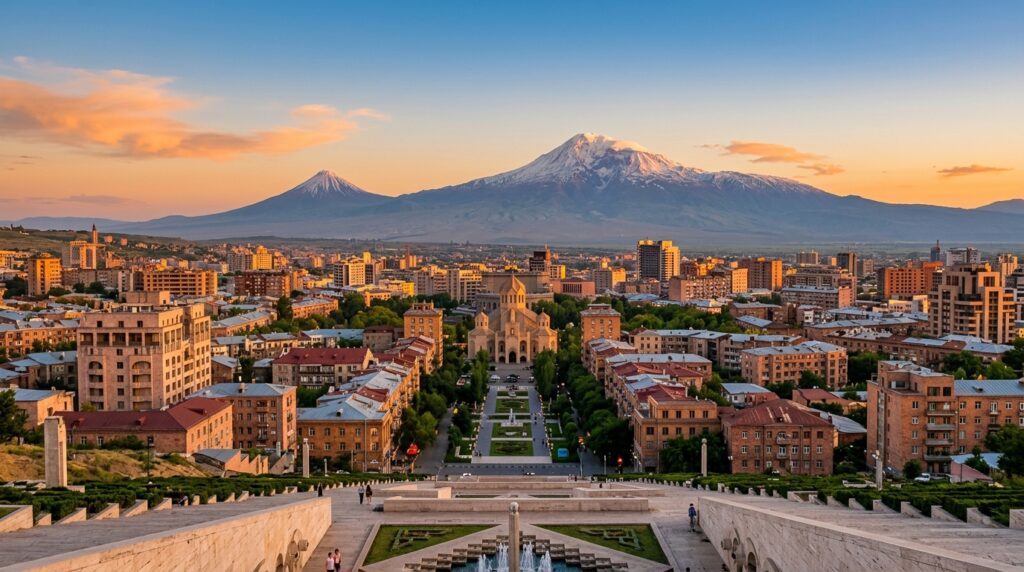
Yerevan, Armenia
Famous for: Republic Square, Cascade Complex, Matenadaran, Mount Ararat views, Areni wine region, Geghard Monastery
Every conversation in Yerevan eventually comes back to Ararat — Mount Ararat, the biblical peak where Noah’s Ark supposedly landed, which dominates the city’s skyline despite technically being in Turkey. It’s Armenia’s great heartbreak and great pride: they can see it every day but can’t touch it. On clear mornings, when the twin peaks of Greater and Lesser Ararat catch the first light and turn pink above the city’s pink tuff-stone buildings, it’s one of the most beautiful urban panoramas on earth.
I had arrived from Tbilisi on the cross-border bus from Georgia, and as the city materialized in the valley below — all rosy stone and wide boulevards and that impossible mountain floating on the horizon — I felt that particular traveler’s thrill of knowing I’d landed somewhere special. I checked into my hotel near Republic Square and set out to explore a city that’s been continuously inhabited for 2,800 years.
Day 1: Republic Square, the Cascade, and Brandy
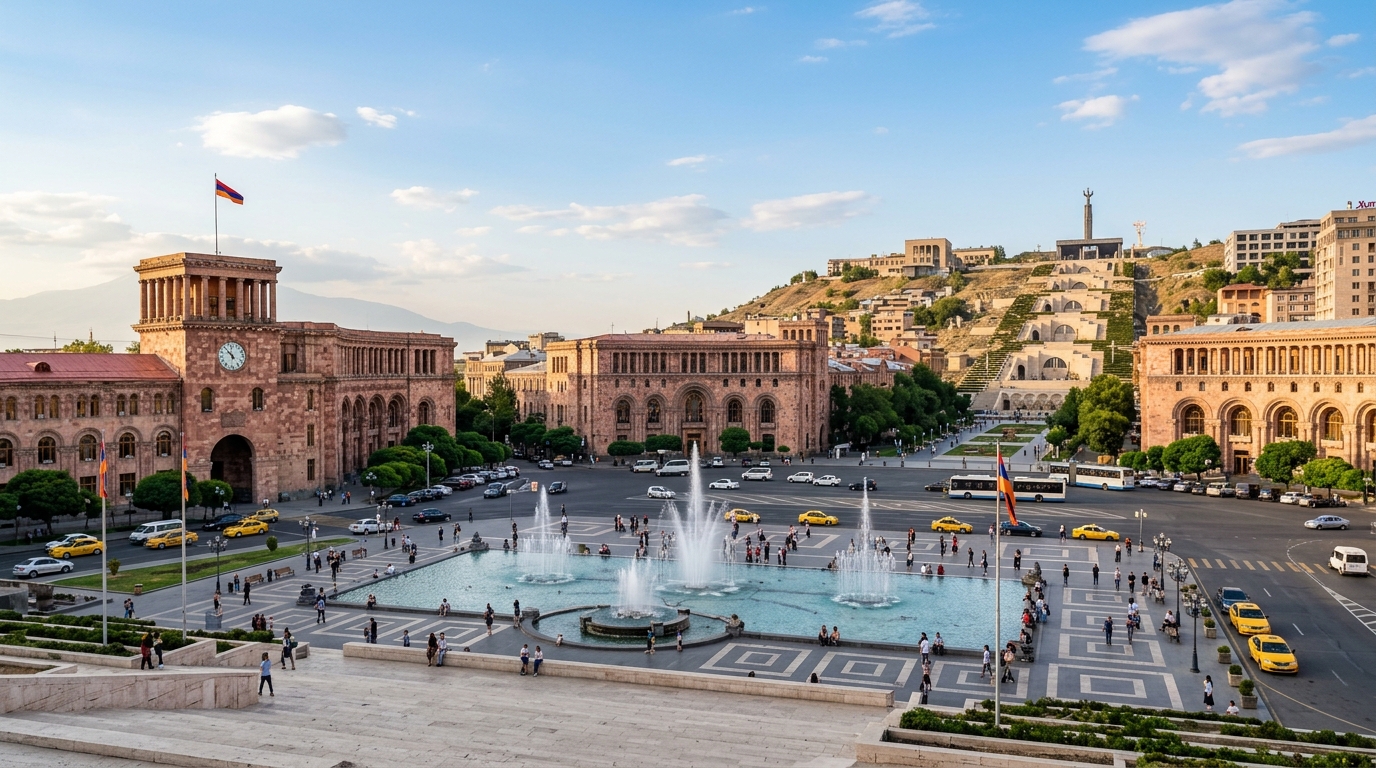
Republic Square is Yerevan’s grand centerpiece — a Soviet-designed oval of pink volcanic tuff buildings with singing fountains in the center. At night, the fountains put on a light-and-music show that draws half the city. But even by day, the square is impressive: the History Museum, the Government House, and the Marriott hotel form an elegant ensemble that manages to be both Soviet and distinctly Armenian.
From the square, I walked up Mashtots Avenue to the Cascade — a massive limestone stairway-monument decorated with modern art, including a Botero sculpture at the base (one of those characteristically rotund cats). Climbing the outdoor steps takes about twenty minutes and rewards you with increasingly dramatic views of Ararat. At the top, a panoramic terrace stretches the vista to the full mountain range. Inside the Cascade, the Cafesjian Center for the Arts houses a world-class collection of contemporary art that most people outside Armenia have never heard of.
In the afternoon, I visited the ArArAt Brandy Factory — yes, the one Churchill famously loved. I booked a tour with tasting at the ArArAt Brandy Factory, where I learned that Armenian brandy (they call it konyak) has been made since 1887 and that the aging cellars hold barrels reserved for special occasions dating back decades. Tasting the 20-year Nairi was a revelation — smooth, complex, with notes of dried fruit and vanilla. I bought a bottle that didn’t survive the week.
Day 2: Genocide Memorial, Vernissage Market, and Lavash
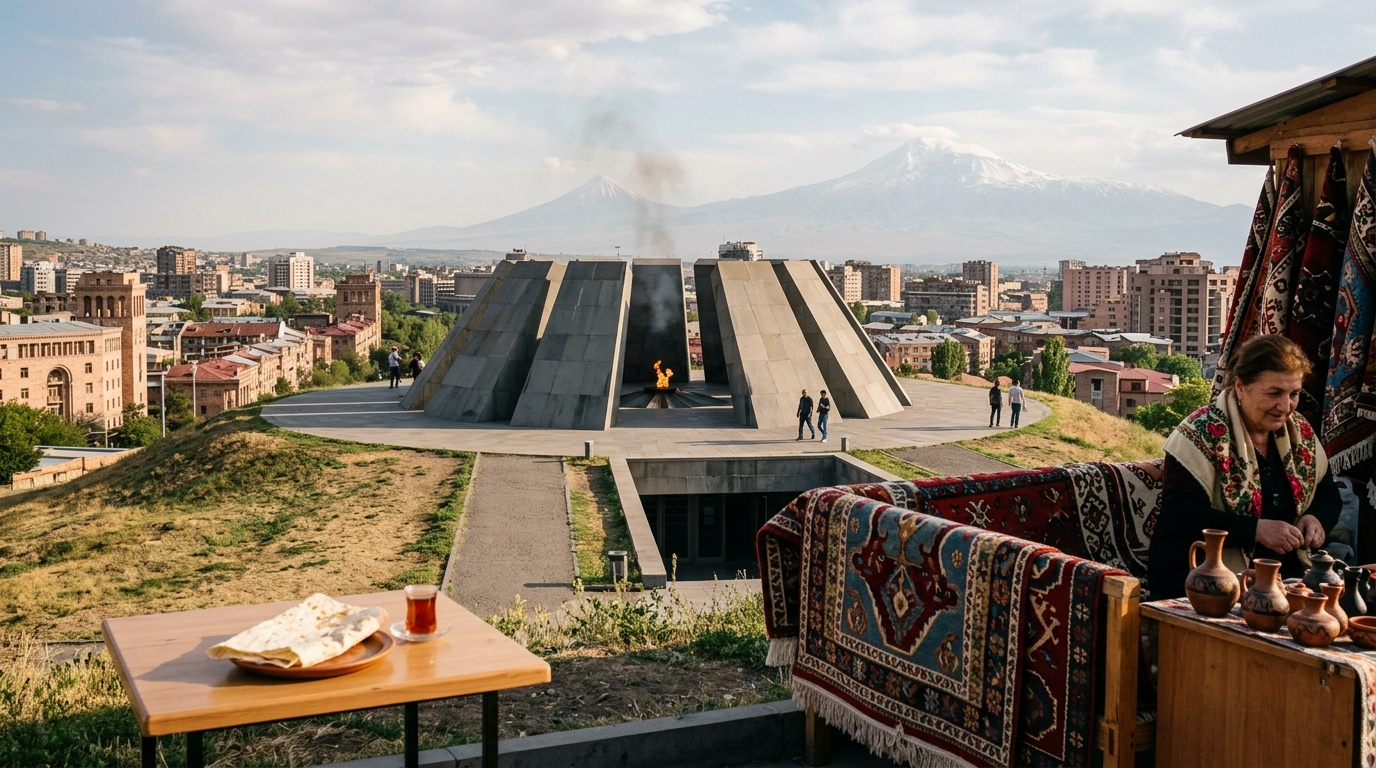
This was the heavy day, and it needed to be. The Armenian Genocide Memorial and Museum (Tsitsernakaberd) sits on a hilltop overlooking the city, and it’s one of the most powerful memorial experiences I’ve encountered anywhere. The memorial itself — a circle of twelve basalt slabs leaning inward over an eternal flame — is deeply affecting. The underground museum documents the 1915 genocide with photographs, documents, and testimonies that are harrowing and essential. I spent two hours there and came out shaken. Every visitor to Armenia should make this pilgrimage — it’s central to understanding the Armenian identity.
To lighten the mood, I headed to the Vernissage Market, Yerevan’s weekend open-air bazaar near Republic Square. Woodcarvers, painters, jewelers, and carpet sellers spread their wares along a tree-lined boulevard. I bought a hand-carved backgammon set (nardi is Armenia’s national obsession) and a pomegranate-shaped ceramic — the pomegranate is Armenia’s unofficial symbol, representing fertility, abundance, and the Armenian diaspora’s scattered seeds.
For lunch, I watched lavash being made in a tonir (underground clay oven) at a restaurant that let customers observe the process. Two women worked in perfect rhythm, slapping thin sheets of dough onto the oven walls, where they baked in seconds. Lavash is UNESCO-listed as intangible cultural heritage, and watching it made fresh is almost spiritual. I ate it wrapped around fresh herbs, white cheese, and grilled meat, and understood why Armenians consider bread sacred.
That evening, I joined a food and wine walking tour through the city center, sampling everything from sudjuk (spiced dried beef) to gata (sweet pastry with a tahini-like filling) to Armenian wines from the Areni region. The wine scene here is booming — Armenia is home to the world’s oldest known winery, dating back 6,100 years, and modern producers are reclaiming that heritage with excellent results.
Day 3: Day Trip to Garni Temple and Geghard Monastery
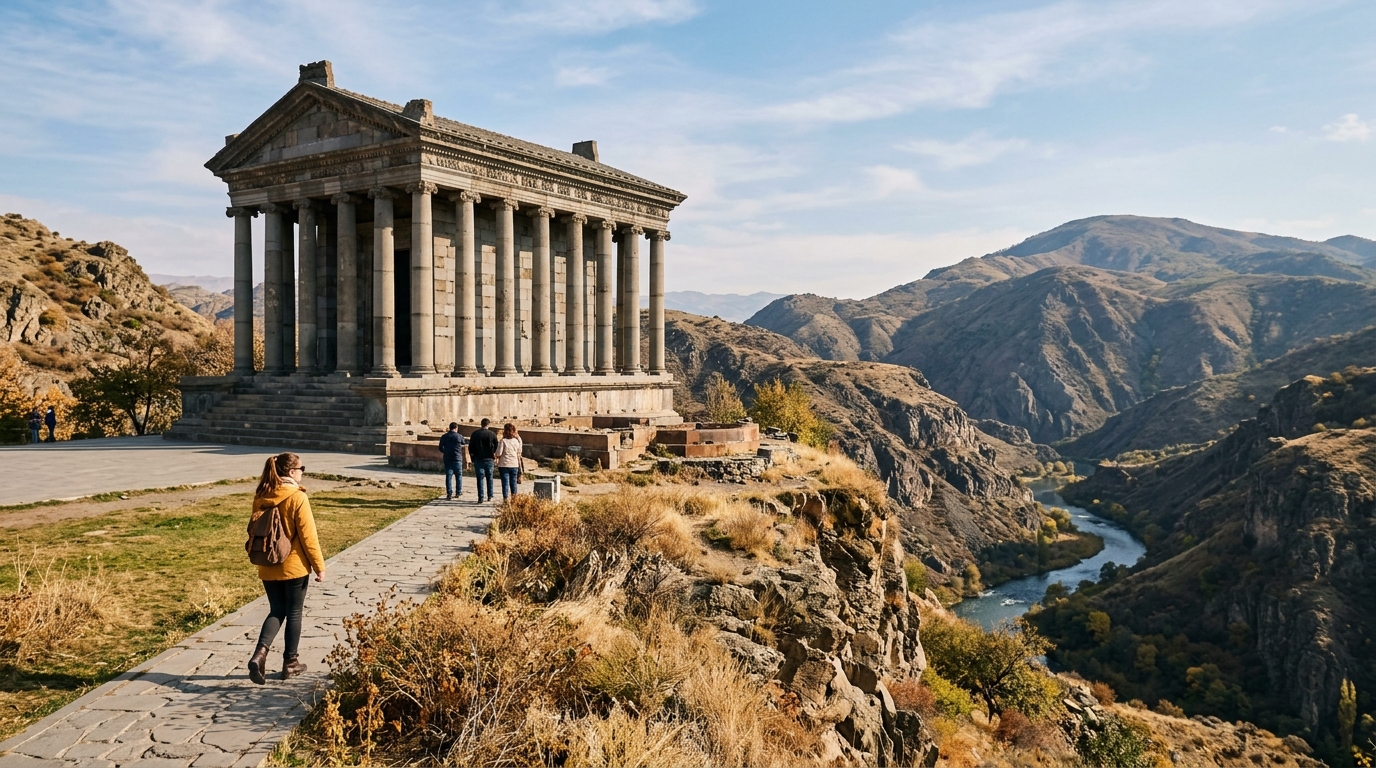
This day trip is the jewel of any Yerevan visit. I booked a day trip to Garni Temple and Geghard Monastery that picked me up at nine and drove me thirty kilometers east into the mountains.
Garni Temple is Armenia’s only surviving Greco-Roman temple — a first-century Hellenistic gem perched on a cliff above a basalt gorge. It looks like a miniature Parthenon dropped into a mountain landscape, and the contrast between its classical columns and the wild Armenian terrain is extraordinary. Below the temple, the Symphony of Stones — a natural formation of hexagonal basalt columns — lines the gorge walls like an organ pipe made by giants.
Geghard Monastery, a UNESCO World Heritage Site, is partly carved out of the cliff face. Founded in the fourth century and rebuilt in the thirteenth, it houses chambers cut directly into the rock, with springs flowing through them. When a group of Armenian singers began an impromptu polyphonic performance inside the main chapel, the acoustics — enhanced by the rock chambers — produced a sound so beautiful it raised the hairs on my arms. That moment, standing in a cave church listening to voices that seemed to come from the stone itself, was the single most memorable experience of my five days.
Our guide also stopped at a roadside stall where a family was making gata in a wood-fired oven. Fresh, warm, with that buttery koritz filling — I ate two before we reached the car.
Day 4: Blue Mosque, GUM Market, and the Opera
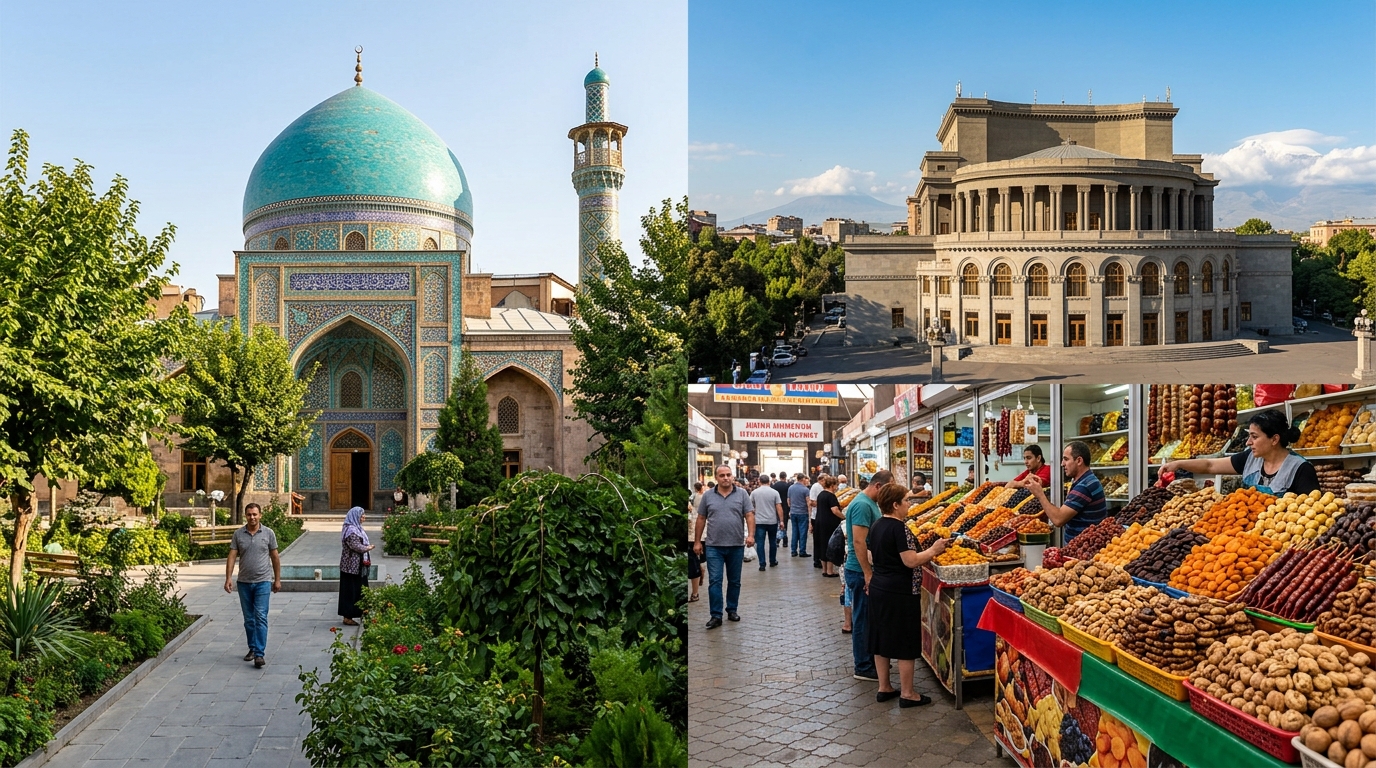
Yerevan’s Blue Mosque is the city’s only functioning mosque, a beautiful eighteenth-century Persian structure with a turquoise-tiled dome and a peaceful courtyard garden. It’s a reminder that Armenia’s history is deeply intertwined with Persia, and the Islamic architectural influence is visible throughout the country.
From there, I walked to GUM Market (officially the Central Covered Market), which is the best place in Yerevan to experience the country’s food culture. Vendors sell dried fruits, spices, pickles, cheeses, churchkhela, sujuk, and every type of preserve imaginable. I spent an hour tasting my way through the market — the vendors are generous with samples and eager to explain their products. I loaded up on sour cherry preserve, dried apricots (Armenia’s national fruit), and a bag of mixed herb tea.
I picked up tickets to the History Museum of Armenia on Republic Square, where the highlights include an ancient leather shoe (the oldest in the world, at 5,500 years), Urartian bronze artifacts, and medieval manuscripts. The museum does an excellent job of contextualizing Armenia’s incredibly long history — this is a civilization that predates Rome by centuries.
That evening, I went to the Opera House, a beautiful Soviet-era building on the edge of a park, where I caught a ballet performance. Opera tickets in Yerevan are astonishingly affordable — I paid the equivalent of six dollars for a good seat. The park surrounding the Opera House is one of Yerevan’s great gathering spots, full of families, chess players, and outdoor cafés.
Day 5: Lake Sevan, Last Walks, and One More Toast
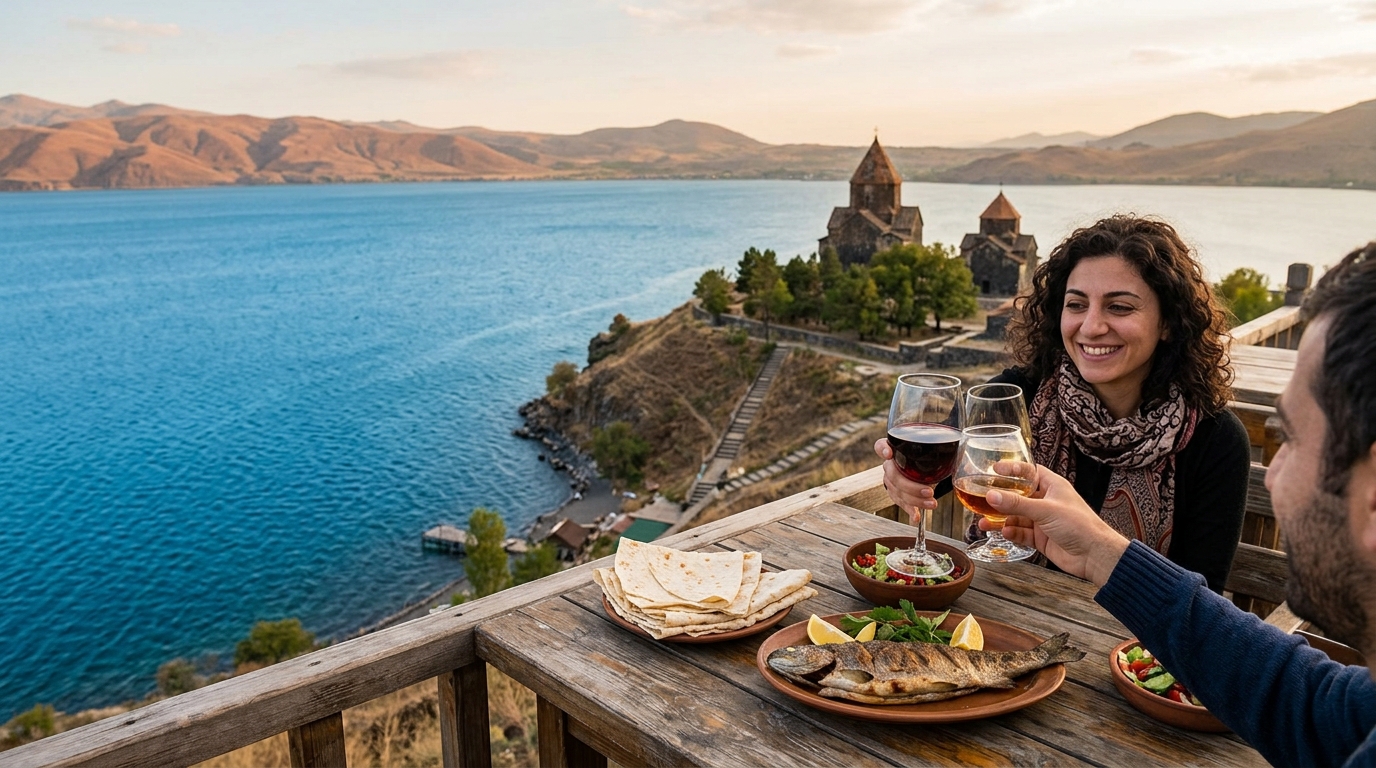
For my last full day, I took a day trip to Lake Sevan, the “Jewel of Armenia” — a massive alpine lake sixty kilometers northeast of the city, sitting at nearly 1,900 meters elevation. The Sevanavank monastery on the peninsula (formerly an island before Soviet-era water diversion lowered the lake level) offers panoramic views across water so blue it looks dyed. I ate fish ishkhan (Sevan trout) at a lakeside restaurant, grilled over charcoal and served with nothing but lemon, herbs, and lavash. Simple and perfect.
Back in Yerevan for my last evening, I did what Armenians do: I gathered friends. Over five days, I’d accumulated a small circle — my hotel receptionist, the couple from the café, a guy I’d met at the brandy factory — and we ended up at a restaurant in the Saryan Street wine bar district, toasting everything worth toasting. Armenians have a saying: “Where there are Armenians, there’s a table, and where there’s a table, there’s no shortage of talk.” This proved accurate.
If you’re heading onward, the train to Gyumri takes you to Armenia’s second city, which has a wonderfully different character — more bohemian, more raw. Or head south toward the wine region of Areni and the spectacular Tatev Monastery. For maximum flexibility, renting a car is the best way to explore the countryside — the roads are decent and the distances are short.
Practical Tips & Budget
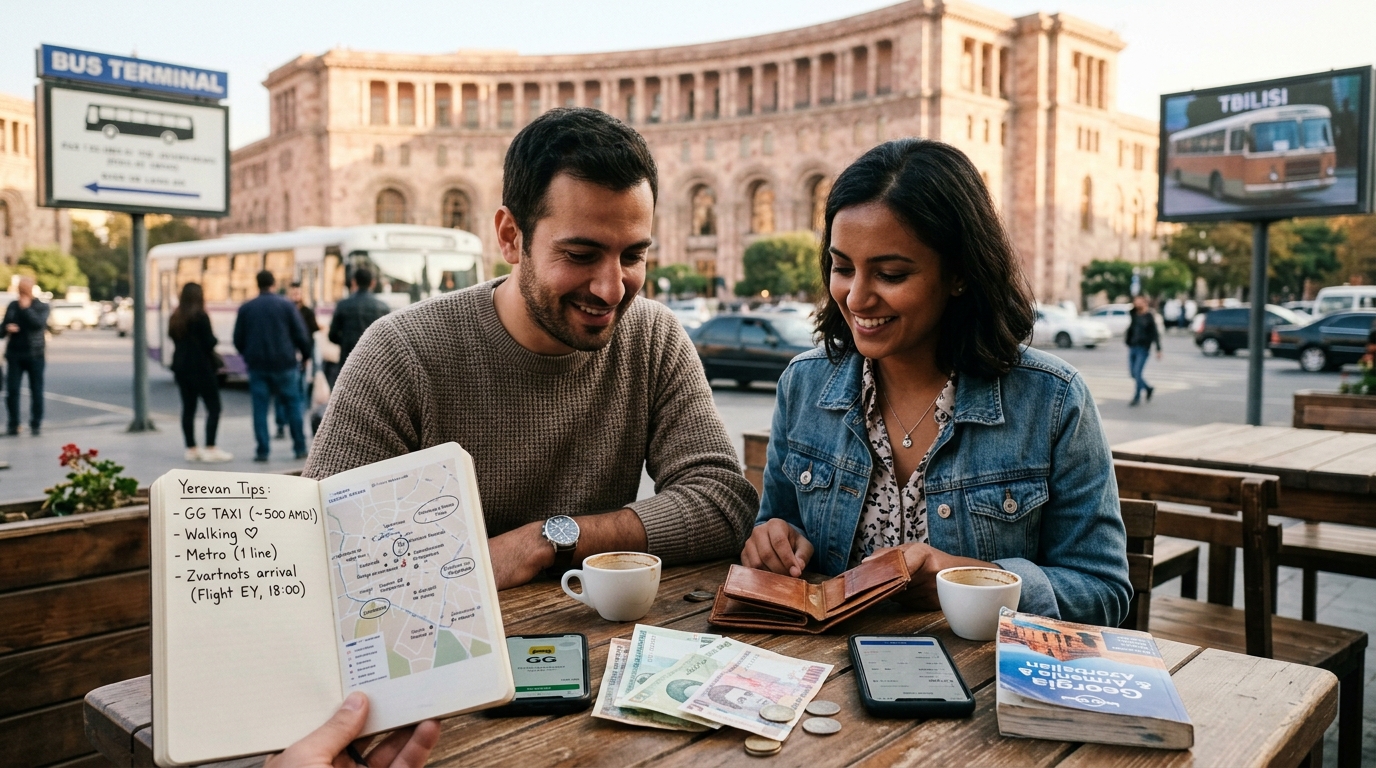
What to know before you go to Yerevan:
Getting There: Zvartnots International Airport has flights from most Middle Eastern and European hubs. The bus from Tbilisi takes about six hours and crosses a spectacular mountain border. There are also buses from Tehran.
Getting Around: The metro has one line and is useful for a few stops. Taxis via GG (the local ride-hailing app) are very cheap — most rides in the center cost 400-600 dram ($1–1.50). Walking is ideal for the compact center.
Where to Stay: The area around Republic Square and Northern Avenue is the most convenient. Saryan Street puts you in the nightlife zone. Kentron district in general is where you want to be.
Budget Breakdown (per day):
- Accommodation: $15–40 (hostel to mid-range hotel)
- Food: $8–18 (street food to restaurant meals)
- Activities: $5–15 (museums are cheap; many churches are free)
- Transport: $3–8 (taxis, buses)
- Total: $31–81 per day
Money: Armenian dram (AMD). ATMs are plentiful. Cards are widely accepted in the center. Carry cash for markets and taxis.
Best Time to Visit: Late April through June and September through October offer the best weather. Summers can be brutally hot (40°C+). I visited in early April and had cool mornings, pleasant afternoons, and snow-capped Ararat gleaming in the sunshine.
Language: Armenian has its own alphabet (one of the most beautiful in the world). Russian is widely spoken. English is common among younger people in Yerevan but less so outside the capital.
Yerevan sneaks up on you. It doesn’t have the architectural fireworks of Barcelona or the nightlife of Berlin. What it has is soul — a 2,800-year-old soul that’s been forged by conquest, genocide, and survival, and that expresses itself through food, brandy, music, and an almost aggressive generosity toward strangers. Come for Mount Ararat. Stay for the people who live in its shadow.


Leave a Reply